Category: Politics

  • Insight into the American Election Re-Cycle

    Insight into the American Election Re-Cycle

    I was listening to election results on the radio recently and a phrase caught my attention. The commentator said that the Iowa caucus in the first week of 2012 was the beginning of the 2012 election cycle. I hadn’t thought about it before but the phrase “election cycle” is accurate in one sense but is false and misleading in another sense.

    Every 2, 4 and 6 years there is an election in the US. The presidential election is on a 4-year cycle. A Representative in the US House of Representatives must stand for re-election every 2 years. And a Senator in the US Senate must stand for re-election every 6 years, but every two years one-third of the 100 Senators is involved in an election cycle. So, yes, there are election cycles.

    But let’s look at the elections in a different way.

    A Congressperson is up for an election every so often on a regular basis, hence the the name election cycle. But most of those Congress people, Representatives and Senators alike, are re-elected again and again and end up serving in the US Congress much longer than just one term in office. Here is are statistics about re-elections from the Internet :

    In November of 2004, 401 of the 435 sitting members of the U.S. House of Representatives sought reelection. Of those 401, all but five were reelected. In other words, incumbents seeking reelection to the House had a better than 99% success rate. In the U.S. Senate, only one incumbent seeking reelection was defeated. Twenty-five of twenty-six (96%) were reelected.

    My point is that what is actually happening before our eyes is so obvious that we, the electorate, don’t see it: that is, when we talk about the actual election process — putting people into elective office — we should refer to it as the “election re-cycle.” We are fooling ourselves to think otherwise. Incumbents have advantages over challengers: “perks in office, exposure via the media, campaign staff.” And they are in a position to gather much larger war chests for re-campaigning than are their challengers. Money is a major reason that a person elected to the US Congress tends to stay in Congress.

    So, let’s refer to the congressional elections process as an election re-cycle. That way the American public will know what it is doing when it votes. They are unthinkingly tethered voting for the incumbent. Not a very democratic process in my view.

  • Violence in Mexico: What’s the Cold War got to do with it?

    Violence in Mexico: What’s the Cold War got to do with it?

    Mexico is plagued (the correct choice of words. Another might be infested) with gangs that live and die by violence. While philosophers and economists have labored for centuries about how to put a monetary value on a human life, in Mexico today the value of life to any one of those drug-related gangs is but a few dollars, the cost of a bullet or two.

    There is no line drawn between the guilty targets of one gang against a rival gang and innocent bystanders. It seems that the gangs are trying to intimidate their rival gangs by killing innocent bystanders in the area controlled by their rival gangs. When they can’t strike out at each other they strike out at innocent people. Anyone, anywhere — butcher, baker, candlestick maker — has become fair game in this Mexican style “proxy gang war.”

    Proxy wars were common during the Cold War decades. The Soviet Union and the United States were engaged in an ideological do-or-die war of ideologies with each superpower backed up by its large and growing nuclear arsenal. But because both countries possessed nuclear weapons, they sought to avoid a heated conflict that could potentially escalate into a hot nuclear conflict. So, they resorted to the use of proxy combatants with each superpower supporting one or the other side in a conflict: north vs south Korea, north vs south Vietnam, east vs west Germany, Chang Kai Shek’s China vs Mao Tse Tung’s China, and so it went right up to the collapse of the Soviet Union in the early 1990s.

    Much of the Cold War rhetoric was centered on terror tactics of which there were two types, one focused on force and the other focused on value. Force meant one country would threaten to strike at the army of the other: if you strike first, we will go after your military bases and other installations. The second type was based on value or threatening to strike back at non-military (soft) targets such as highly populated urban centers, if provoked.

    Strategies were then developed to counter such types and were called counterforce and countervalue, with follow up programs to harden the defense capabilities of urban areas as well as military establishments.

    So, can the Cold War serve as an analogue to current situation in Mexico?

    The situation in Mexico, as I see it, is one of a “proxy war” that is focused on value: that is, where rival drug gangs seek to intimidate each other by going after the public within the territory of its rival gang to expose vulnerabilities and the proverbial Achilles heel of the rival gang. The government is helpless and apparently hapless in protecting its citizens. It has no counter value strategy and cannot guarantee the safety of its citizens.

    The question then becomes, who needs a government that cannot protect it from hostile forces? Isn’t this one of the basic inalienable rights of citizens in their exchange for loyalty to the government, sort of an unwritten social contract between governed and governors?

    What then is the government to do — business-as-usual by letting the rampant violence continue while protecting enclaves of the wealthy within the country? Or should it concede that the situation within its borders is out of its control and call for international assistance to go after the destabilizing gangs?

    the people protest drug wars in Mexico, 2011

    To do nothing would be to allow for a situation like the one that exists far away in the heart of Africa, in the Congo in the heart of Africa to continue. A government that accepts the status quo — violence in areas out of its control, is accepting “anomie” a situation in which unstructured violence can prevail. [NB: ” French sociologist Emile Durkheim used the concept ‘anomie’ to talk about the dangers that people in modern societies experienced. He constructed this French word ‘anomie’ (meaning without ‘norms’ or social laws) to describe the dysfunctional aspects of modern societies.” (yahoo.com)]. Does this describe what is happening to our neighbor to the South?

    America’s hands are not clean. Americans buy the drugs that those gangs illegally send North to us. In large measure Americans have a collective responsibility for what has happened to Mexico.

    Is it too late to reverse the violence to the South or the drug use to the North? Only time will tell, but there is not a lot of time left to resolve this situation. Sometimes it makes me think of the movie “Mad Max.”

  • What comes after a post-service society? – oligarchy

    What comes after a post-service society? – oligarchy

    The three major stages of economic development are as follows: the primary sector, dependent on the exploitation and sale of primary resources such as forests and mineral resources; the secondary sector is based on manufacturing and the tertiary sector is based to a large extent on providing services. As noted elsewhere, the 1950s and 1960s saw discussion of the possibility of an emerging post-industrial society. Well, we are there now in America. In fact we seem to be nearing the end of it, in large measure as a result of outsourcing not only our manufacturing activities but now our services as well. My lament was captured in the question, “what happens in a post-service society such as ours? What’s next? Yesterday I did not know. Today I think I do. Tah Dah! An oligarchy.

    America is well on its way to becoming a full-fledged oligarchy, that is the rule of a few for the benefit of a few. Here are some definitions of oligarchy.

    1) a small group of people having control of a country, organization or institution; (2) a state governed by such a group; (3) a form of government in which all power is vested in a few persons or in a dominant class or clique; (4) power essentially rests with a small group.

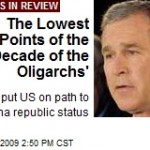
    The lowest points in the decade of the oligarchs. Worse is yet to come?
    The lowest points in the decade of the oligarchs. Worse is yet to come?

    It seems that the oligarchy becomes the “last social class still standing,” having weakened or destroyed the power, means and will of other classes in society. Media moguls, political party leaders, congresspeople, Fortune 1000 CEOs, and the like, hold sway over which laws get proposed, which laws are passed and which ones are rejected. The Supreme Court members as well are among the ruling elite.

    A major difference between our oligarchy and those of earlier times in other places is that the American public is super-polarized now by political, economic and cultural ideologies. It has increasingly becoming a country of one-issue voters, who often end up voting against their own long-term personal and class interests. They are somehow convinced that all taxation is bad, even of the super-rich. They believe that public education is a waste of money, that religious schools should receive public monies, they believe they should be able to divert contributions from social security into the stock market despite the decadal market crashes. They support candidate of big business who support and foster outsourcing of American jobs. They support people who see corporations as deserving legal rights equal to those that people have. They seem to support lawmakers who so no to everything that a non-white president favors without having to give substantive arguments as to why.

    We have become a nation of sheep. We follow whomever we think should be the leader. We oppose change out of ignorance. We do not understand issues that we vote on or people that we vote for. We take irrational stances on issues that directly affect the country’s and their own personal well being in the long run.

    Sadly, it seems that America is well on the way to becoming a nation “of the oligarchs, by the oligarchs, and for the oligarchs.” The Golden Rule seems to prevail yet again: those with the gold make the rules…even in a so-called democracy. It is different today as well, for the Golden Rule is out of control of anyone, except the oligarchs, as they vote themselves laws forbidden that they be taxed. So many workers pay more taxes than do many a wealthy corporation (GE, EXXON, etc) or a CEO of a Fortune 500 company, thanks to Bush’s tax breaks for the rich.

    NB: The Bush image is on www.newser.com

    NB2: The medicare slogan underscores ignorance of some voters who do not realize Medicare IS a government program! Such signs have appeared at Tea Party rallies in the USA.

  • A Funny Thing Happened on the Way to Another Country

    A Funny Thing Happened on the Way to Another Country

    Reflections from my hotel, about to leave for the airport to go home…

    I came to realize that the mighty US dollar is mighty no more. Its value compared to other currencies seems to be moving southward. Soon I fear it will be equal to the peso or dinar, or rupee or yuan. The prices everywhere move up at the same time the dollar’s purchasing power declines.

    It used to be that the US dollar was a cherished, sought after commodity. Not so now. In Japan, for example, the value of the dollar dropped in only twelve months mind you from 94 yen to the dollar to 72 yen to the dollar at a Tokyo bank. Prices for goods and services in yen seem to have remained the same.

    I have been hearing ever since I can remember that a comparatively weaker dollar is good for the US economy because it encourages others outside our borders to buy our products. But, now I ask, what products? What do we make in the USA?  What is it that we manufacture in the USA that others are seeking to buy in great quantity? What’s left that says on the label “Made in the USA”? We’ve outsourced a lot of it. In fact we have become primarily a service society, a society of paper-pushers. But wait… now we are outsourcing our services too. We’ve cheapened the real and the perceived value of the dollar and getting nothing of benefit in return; a formula for a downward spiral of America’s prosperity.

    "Are we there yet?"
    the Great American Depression: Are we there yet? Now apples are a buck each!

    Decades ago in the 1960s there were several books around the theme of a post-industrial society. They recounted the mantra of developing economies where as economic development occurs a country moves from dependence on selling off its natural resources (wood, ore, oil, etc) and dependence on working the land to a manufacturing-based economy and then nirvana — a service-based economy.

    At each of these three stages personal wealth and well-being improved for many people as did the quality of life. But, what follows a post-service society? What do America’s potential workers have to look forward to? These are uncharted waters, as far as I can tell. Will the future be a crumbling of that great service society, a crumbling that ratchets everyone down to lower levels of well-being (except those who benefit from the end of society as we know it)? Will it be a new, fourth, even higher level of development than before or might it be a logical return to producing something of real value instead of a society of workers whose purpose is to shuffling papers across a desk or transact in the virtual work of the Internet? Are we producing an army of unemployable citizens? I hope not.

    I don’t know what the future holds for the fourth stage — a post-industrial society, but I sure do hope smarter people than me are thinking seriously about it. (and I don’t mean two-handed economists or politicians who blather about the future but have no real clue about what to do: “on the one hand… blah blah blah, but on the other hand blah blah blah…”)

    My cynical side says they are not. WTF? 

  • Roses are Red. Violets are Blue

    Roses are Red. Violets are Blue

    – Politically speaking, US States are too…

    A common phrase one hears these days about education in America is that Americans are being dumbed down. How can that be? Earlier generations had less information at their fingertips than kids today have. We did not have the Internet to fall back on a few decades ago; nor did we have smart phones with which to make instant searches for information. We were tethered to libraries. We did not have hundreds of TV channels to choose from. We did not have the capability to read news headlines from around the globe at any given instant. So, how can people say that Americans today are being dumbed down? I, for one, don’t believe we are being dumbed down. I believe that we, the American public, have already been dumbed down.

    DUH !! Medicare is a government program!! Tea Party'er visit Earth.

    I blame the political process and, for example, the notion of red and blue states (purple states came later). Red signifies conservative states and blue represents the liberal states. The community-based “we” has all but disappeared. We learned in elementary school about the political slogan from the late 1750s to keep the colonies together against the British colonizers, “United We Stand. Divided We Fall.” We have become a nations re-divided. It seems that issues are no longer viewed in different shades of grey but as black or white.

    American Political Scientist Robert Dahl once wrote about political divisions he called cleavages. As I recall, he highlighted the importance of “overlapping cleavages.” That referred to political compromise. While A and B might be opposed on one issue they could be united on other issues. So, they understood our political system; they needed each other to get polices passed that they favored. I will vote your way today because I might need you to vote my way tomorrow.  The danger, however, lays in what we have today, “reinforced cleavages.” On just about every issue — taxation, health care, social security, wars, supporting the unemployed, prison sentences for Wall Street scammers— the red and the blue politicians and their loyal supporters oppose each other with a vengeance. There is no chance for compromise, only stalemate. And the longer the stalemate continues, the worse off the country becomes: and “Divided We Fall.” Our forefathers had the foresight to see that 250 years ago. With all the electronic ways to can get information today, we have neglected their warning.

    Tea Party'ers also have asked to keep the government out of their social security. Unbelievable. and they vote!

    The American public is dumbed down and I am not sure it can get much dumber. The dumbing is due in part to ignorance and trust (people are so busy figuring out how to feed their families in these hard economic times that they are relying on political candidates that look good to the eye (nice hair, pearly white teeth, pretty smile, folksy chatter, glad-handers) but may have little idea how our government works.

    On the other hand there are those who suffer from “ignore-ance,” and the only facts that are relevant are those they choose to believe. They are often ideologically driven. Their behavior undermines the constitution they were elected to uphold. If, for example, the law of the nation is at cross-purposes to their ideological preferences, then the law of the land be damned in their view. True facts, scientific facts, are thrown in the dustbin in favor of gut-feelings, their own or those of their corporate backers. As much as a politician might believe the USA is number one is science, technology, education and health care, it is not so. On such comparative lists we are in the double-digit category.

    Another driving force that is dumbing down America is the media, which operate these days on a 24-7-365 schedule. There is no longer such a thing as a slow news day. With the globalization of instant news, we know immediately about the dog that was saved 11 days after it washed out to sea due to the devastating tsunami in Japan. Thanks to Twitter we know what a foreign friend is eating for lunch on the other side of the globe. We see lots of silly 3-minute videos on YouTube. Reality shows draw millions of viewers who are escaping their own reality for a few hours. And the media too seems to have become polarized with red and blue media (and some purple [bi-partisan] ones in-between). 

    I am presently at a loss on how to turn this situation around. How can we un-dumb Americans, people on the street and their politicians? How can we get back to a “United We Stand” way of life and of policymaking? How do we bring back a sense of community, and not just a red community vs. a blue community? The public has to take charge again. It has to put time in to being a citizen once again, to understand issues of democracy and how it works.

    In the back of my mind I harbor the feeling that maybe the “Leave it to Beaver” days of the 1950s were not so bad.


  • “An IPCC dilemma: Who to trust talking to the media, its critics or its colleagues? ” Mickey Glantz (July 12, 2010)

    “An IPCC dilemma: Who to trust talking to the media, its critics or its colleagues? ” Mickey Glantz (July 12, 2010)

    The title of this editorial is a play on words with a bottom-line message: whom should you keep your eyes on — your enemies (critics) and or your colleagues, when it involves talking with the media about IPCC’s 5th Assessment findings.

    A colleague of mine, Ed Carr at the University of South Carolina, received a letter from the Head of the IPCC (Intergovernmental Panel on Climate Change) cautioning those selected to prepare the next (5th) Climate Change Assessment Report not to talk to the media, leaving that task to the IPCC Secretariat.

    Ed Carr wrote (his blog in just below this one):

    So I [Carr] was dismayed this morning to receive a letter, quite formally titled “Letter No.7004-10/IPCC/AR5 from Dr Pachauri, Chaiman of the IPCC”, that might set such transparency back. While the majority of the letter is a very nice congratulations on being selected as part of the IPCC, the third paragraph is completely misguided:

    “I would also like to emphasize that enhanced media interest in the work of the IPCC would probably subject you to queries about your work and the IPCC. My sincere advice would be that you keep a distance from the media and should any questions be asked about the Working Group with which you are associated, please direct such media questions to the Co-chairs of your Working Group and for any questions regarding the IPCC to the secretariat of the IPCC.”

    It is clear that the IPCC still has a problem. It claims the problem is with the media, or at the very least it strongly hint at that. However, in this day and age, if one type of news medium does not catch IPCC scientists off guard another type will. That is what the media is paid to do. I would argue that secrets are hard to keep from the media and are hard to be kept by the media.

    A political ‘rule of thumb’ is that ships of state (eg, governments) tend  by metaphor to leak from the top; that is, leak confidential information to reporters either to reinforce a political position or to undermine it. I would argue that the same rule applies to the IPCC as a scientific climate-change- related ship of state. Leaks about scientific deliberations came from within the IPCC science community. Partly it is due to the persistence of reporters and science writers and partly it is because of the egos of some scientists who thrive on media attention. [NB: climategate was the result of hacked emails and NOT the result of loose lips (off-hand comments) by IPCC scientists (as far as we know).]

    So, it seems that the email directive and the defense of issuing it by the Head of the IPCC makes little sense. instead of embracing openness with the general public, the IPCC leadership has chosen to cast another shadow about the objectivity of the forthcoming 5th scientific climate change assessment. Is there something to hide? I don’t think so. Will the public be led to believe that there is something to hide? I think so.

    Instead of emerging from the climategate situation feeling exonerated and with heads held high, the IPCC leaders seem to haves come out of it paranoid and less secure about how its work presented by the media to the public.


    Transparency is the best cure for the IPCC’s image. Even with critics at the door and media as well, the best strategy to pursue is to pursue openness. Good objective science will win out. Policing the comments of your colleagues (eg, friends) will likely generate frustration and resentment thereby converting friends into “frenemies” (friendly enemies who support IPCC science but not the IPCC process).

  • Solving America’s Health Care problems in one easy step! Mickey Glantz, March 1, 2010

    Solving America’s Health Care problems in one easy step! Mickey Glantz, March 1, 2010

    The country is so polarized on just about every issue and health care is no exception. A year passed and Obama’s Administration devised a plan that some like and some despise. The opponents of the president’s plan call for starting the process all over; forget what’s been discussed so far. The supporters of his plan are calling for pushing through health care reform without kowtowing to the Republican opposition. There is no other solution that can overcome the political polarization that exists in the USA today.

    The American Public signs a petition demanding that people in hte general population get the same health insurance coverage and premiums that the members of the US Congress presently enjoy. If it is good enough for Congress persons, it should be good enough for the people who elect them.

    Access to Cheap Health Insurance and Care is a Congressional Right but not a Public Right, according to the US Congress Senators and Representatives.
    Access to Cheap Health Insurance and Care is a Congressional Right but not a Public Right.

    Alternatively, we could also petition that Congressional representatives receive no special coverage from the US Government and have to shop for health insurance coverage like their constituents.

    How about starting a national campaign to gather signatures on a petition to send to Congress, Senators and Representatives alike.

  • Limbaugh, lemmings and the “Oxycodone ate my brain” line of defense

    Limbaugh, lemmings and the “Oxycodone ate my brain” line of defense

    Limbaugh, lemmings and the “Oxycodone ate my brain” line of defense

    Mickey Glantz
    FRAGILECOLOGIES

    October 22, 2009

    I am ashamed on behalf of rational America of Rush Limbaugh’s lack of civility. He suggested on air that a New York Times journalist should kill himself. In the same vein as not being able to yell “fire in a theater” a talk show blowhard should not be able to call for the death of anyone because there are nutcase followers who are hanging on Limbaugh’s every thought, however crazy and ill-conceived those thoughts might be. Seems like Oxycodone still rules Rush’s brain. And to the FCC, bring civility back to the talk show hosts on radio and TV.

    Limbaugh to me is like a fly in the proverbial ointment. He is there and you figure out how to either ignore it or get rid of it. I choose to ignore it/him. Blowhards are just that, blowhards. They say things that are outlandish or outrageous as a call for attention. His latest skirmish with reality (which is so weird) is Limbaugh’s public suggestion to New York Times science writer Andy Revkin, that Revkin should “kill himself “ as a gesture to save the planet from human activity. That sounds like an American-grown “fatwa”, this coming from an alleged spokesman for the Republican Party who claims to be so anti-jihadist. [NB: according to “About.com:Islam”, The people who pronounce these rulings are supposed to be knowledgable, and base their rulings in knowledge and wisdom]. Ooops. that does not seem to have been the case here!!

    Limbaugh’s fatwa on Revkn is reminiscent and more extreme than the right wing view that “if you don’t love America, then you should leave it” {which really means if you don’t agree with the right wing then leave the country}. I can see the bumper sticker now that will adorn Hummers and other gas-guzzling cars, “Love the Planet or Leave it”. So much for the image of America’s tolerance of opposing views. fatwa

    But could it be just a play by Limbaugh for higher media ratings? Should he get a free ride with those who oversee the media? Did he cross a line of civility with regard to the use of the public airwaves? Is Limbaugh our generation’s Father Coughlin [the 1930s leader of the anti-Semitic Christian Front]?

    His latest outrage leads me to believe that Limbaugh’s dependence on narcotics (Oxycodone, among other illegally gained drugs of his choice] to get him through his day a few years ago has had an impact on his ability to think rationally about what will come out of his mouth on the public airwaves. Are his inner thoughts tripping off his tongue before he can edit them?

    He has a following , many are acting like political lemmings; no need to think for oneself just that believes everything Limbaugh utters. It is not much different than calling for assassination on the airwaves. His personal attacks on Revkin are unwarranted, ill conceived and only serve to divide the country rather than to bridge the difference.

    Limbaugh should be reprimanded for his stupidity and if it really is the case that the drugs have cooked his brain then let’s do the humanitarian thing and get him some psychological help.

  • A message to Iran’s government from a nobody

    I have been watching with interest and sadness the current political election crisis in Iran. It is a crisis the government has brought on itself and the country. It energized the students in the name of a faux-democratic election. The government had no intention to allow an opposition party to take control. So, it came up with unbelievable numbers for president Amenidijad’s alleged victory. Not only that, but the results were announced within a few hours of the polls having closed (millions of paper ballots were counted in no time at all!!!).

    The country’s supreme leader Khameni sided with Amenidjad and called for crushing the opposition. He and the rest of the government are busy blocking international electronic transmissions of photos, videos and text and busy blaming everyone for the street protests, everyone but the true source of the crisis: the current Iranian regime.

    I sympathize and empathize with the people in the streets, yearning for a democracy and their human and political rights. Iran’s political progress has been set back to (really, exposed as) a dictatorship. The Iranian students and other people from all walks of life who oppose the repressive government have been let out of Pandora’s Box. Maybe the people can be repressed again as in past revolts since 1979, but the government will now have exposed what it really is, a repressive oligarchy, the rule of a relatively few for the benefit of that few.

    Why am I prompted to write now? I watch a young martyr die in the street in her father’s arms. Neda is her name. She is dead but I say “is her name” not “was her name” because her spirit and fight for freedom on behalf of her countrymen lives on. She was shot by a government sniper. There was a video taken of her being shot and then dying. It was a horrible image to watch but Neda to me is the symbol of the revolution that is underway.

    Surely, sanctions on the Iranian government will follow and Iran will become further isolated from the community of nations. Amenidijad will continue to represent a crazed element of the government. One can only hope that he will be replaced by a more rational politician in the not so distant future.

    The following phrase on the Internet sums it up: “Khameni and Amenidijad are the enemies of their people. Even the Shah of Iran did not order his police to shoot.”

    Iran’s theocracy is unraveling. Stay tuned.

    mickey glantz

  • Things you can do with a shoe on a rainy day

    Things you can do with a shoe on a rainy day

    Mickey Glantz

    shoe_bush21) You can show displeasure with political leaders or with anyone else. For example, just about everyone in the world watched an Iraqi news reporter throw his shoes at President Bush during a Baghdad press conference. Videos of the incident are all over the Internet, eg, U-tube.

    Shoe used as a political projectile, an act of protest in some cultures ^

    President Bush managed to dodge two shoes. The press conference continued, as the shoeless shoe-tosser was dragged out of the room and to a jail cell.

    Another form of protest using a shoe was the striking of the statue of Saddam Hussein with a shoe. This took place following Saddam’s defeat by the “coalition of the willing”.

    Yet another use of the shoe-as-protest occurred in the United Nations General Assembly in October 1960 when Soviet Union’ leader, Nikita Khrushchev, took off his shoe and banged it on the table top in protest of comments made about Soviet imperialism in Eastern Europe.

    shoes_politicSo, one thing you can do with your shoes is to show displeasure with leaders or policies you do not agree with.

    2) I attended an undergraduate university commencement exercise this month (May, 2009), the first one since June 1961 which was when I got my BS degree at the University of Pennsylvania. Honestly, I only recall a few mental memory clips or episodes from that graduation but I do remember it as a positive event in my life.

    At this graduation, it was great to look out at members of the graduating class dressed in their regalia, watching beaming faces as they receive their diplomas.

    I had the honor to give a short keynote talk to the 250 or so grads and another 750 or so families and friends. I was not sure what they would want to hear, as they entered that morning the last few minutes of their undergraduate education. I chose not to talk of my lifelong accomplishments, or about topics related to my research. Instead, I decided to talk about some things I had learned during the 48 years from my graduation to near-retirement. My talk was titled “ 9 things I know now that I wish I knew when I was graduating”. The reason for this theme was to give the graduates some tips about their future jobs — not words of wisdom but words of ordinary knowledge.

    During the reception that followed the graduation ceremony, one of the graduating seniors told me that she had wanted to take notes from my talk but did not have any paper to write on. So, she decided to take notes on the bottom of her shoe. I was surprised and amazed that she took the effort to do so. I was so amazed in fact that I gave her the paper copy of my talk. The writings on her shoe made me think of another use of a shoe.

    shoes_gradshoe3) A third thing you can do with a shoe on a rainy day was inspired by the graduating student’s innovative use of her shoe. You can write a political message of displeasure about a policy on the sole of the shoe of your choice and toss it to a politician.

    Most likely, the person tossing the shoe to the politician would be arrested, as happened in Iraq (Note: the Iraqi who tossed his shoes at Bush got a 2-year prison sentence; many have protested this sentence. Some even claimed that the reporter was a good person with bad aim at his target — a ‘bad’ president). Actually, there have been other incidents involving tossed shoes and politicians, as noted in the following news account:

    “New Delhi: Following today’s shoe tossing incident, which seems inspired by the infamous incident involving Bush when he was in Iraq, the journalist was detained.” A large crowd gathered at the Tughlak road police station on Tuesday after hearing news that a Sikh journalist from a Hindi daily, Jarnail Singh, had been taken to the police station after he had been detained.”

    I would assume that the shoe tosser would expect repercussions from his or her action. So, one can assume that he or she had weighed the benefits against the costs of the toss. Nevertheless, once the commotion died down following the actual shoe toss, it is very possible that the person to whom the shoe was tossed would sit down in the office and read the shoe’s message. That way he would find out why the shoe had been tossed in the first place. The message on the sole of the shoe would eventually be leaked to the news media worldwide.

    This seems like a win-win situation for all involved. The tosser of the shoe gets jail time and the tossee gets a bit humiliated. Though not very pleasant, this type of shoe-tossing could become a legitimate way to protest a politician or bad policy.

    To my knowledge no shoe tosser to date has had the foresight to write messages to the person to whom he or she has tossed a shoe out of protest. But politicians are not to be outsmarted and soon they would make sure that glass barriers are in place to protect them from shoes.