– Conference of Parties: Don’t compare apples to oranges!
I started to write about the happenings at Rio+20, while sitting in one of its food courts. But I realized I needed more time and distance to formulate my perspective and expectations about Rio+20, so I decided to write these comments after a week at the world’s Second Earth Summit (what Rio+20 should have been called).
After a week at this conclave I came to realize I had fallen into a trap. When I first started to think about the Rio+20, I found myself comparing it to the conference of parties (COPs) of the various UN Conventions in general and more specifically those of the UNFCCC. These political conventions (their structures, functions and expected outcomes) were first formulated at the First Earth Summit.
From this COP perspective, my expectations for results at Rio+20 were cautiously optimistic. I thought we would see some advances in issues related to the three UN conventions on biodiversity, climate and desertification. Despite this measured optimism, however, my first judgments of the recent conference were harsh: no step-like, sorely-needed progress would be achieved; NATO (no action, talk only) would prevail; political posturing (blah, blah, blah) would abound; and a declaration by attending global leaders at the end calling for advances in saving species, capping carbon dioxide emissions and arresting land degradation, respectively, would fail to emerge. The Earth Summit’s platitudes, I assumed, would likely be similar to those made in earlier decades at other international conferences.
I was wrong, I now realize.
The problem was that I was comparing proverbial apples and oranges, an EARTH SUMMIT of leaders (apples) with an accounting of progress made over 20 years through the annual COPs where negotiators are trying, against all political and economic odds, to hammer out a roadmap for the sustainability (e.g. long term into the distant future) for the planet (oranges).

An EARTH SUMMIT is NOT a COP. In theory, Rio+20 is really a Conference of Humanity, the grandchild of the 1972 Stockholm Conference on the Human Environment. In other words, an Earth Summit of global leaders can only legitimately be compared with Stockholm and the Rio1992 Earth Summit.
The climate COPs, on the other hand, are held each year by the UNFCCC’s Conference of Parties, with 17 annual ones having been held so far and the 18th scheduled to be held in Qatar later this year (2012). Negotiators from most countries meet on an uneven climate playing field to iron out different, often competing perspectives on how to prepare for and cope with climate change and its environmental and societal consequences.
Rio+20 should not be viewed as a COP-like meeting. It was—in my view—supposed to look back to assess progress since 1992 (as well as since the forgotten Stockholm conference) with regard to various aspects of human interactions with the environment. Its purpose was not to assess the progress in negotiations since COP 17 in Durban, South Africa last year. Many people (originally, myself included) seem to be judging, often unknowingly, the success or failure of the summit based on political progress since Durban.

There is no doubt that the key to arresting the continued global warming of the atmosphere (or the loss of biodiversity or increased desertification) rests with political leaders and their collective will to act worldwide on the numerous creeping threats to humanity.
But an Earth Summit like Rio+20 is not just a political meeting. It involves all other facets of society: companies, educators, disaster managers, students, etc. This is why it is important NOT to compare the assembly of civil society at Rio+20 to the annual political events that are the COPs.
Looking back to 1992 or even 1972, concern about the state of the planet is at an all-time high. There are many examples of this, not least of which is Kenyan environmental activist Wangari Mathaai’s 2004 award of the Nobel Peace Prize (there is no Nobel Prize yet specifically for the environment). In 2007 the IPCC process, as one drawing recognition to worldwide growing concern about the consequences of a warming atmosphere, received the recognition of the Nobel Committee.
An Excel spreadsheet delineating progress to a healthier interaction of societies and their natural environments would be impressive. Concern expressed in different ways and at different rates has shown up in corporations (greenwashing notwithstanding), in civil society (convening their parallel peoples’ summits), the awakening and empowering of youth (over half of the earth’s population today), in cities large and small (institutionalizing recycling, smart energy use, carbon-reducing programs), in schools from kindergartens to universities (bringing environmental into their lesson plans), governments (shifts to alternative energies), and so forth. Concepts like sustainability, resilience, adaptation, green economy, zero carbon society are now commonly used, even by civil society and not just academics.
So, in this regard Earth Summit is a milestone conference to take stock of successes and to lay out an “Agenda21 + 40” (in 2032). What is missing though, even with the progress that really has been made in awareness and in action, are more aggressive steps toward poverty reduction, toward disaster risk reduction and in electing leaders who have the backbone to make hard decisions the benefits of which will occur well beyond their time in office.
American humorist Will Rogers once said, “Even if you are on the right track, you will be run over if you are not going fast enough.” When it comes to coping with human induced climate change, political leaders are not yet aware that there is a faster train approaching humanity’s chances for surviving as we have come to know and expect it.

A Rio+40 Earth Summit will likely take place too late for many of the vulnerable, people and countries. We have identified many tipping points for environmental change but have yet to identify the tipping point when policy makers will realize they must face the climate change issue head on.
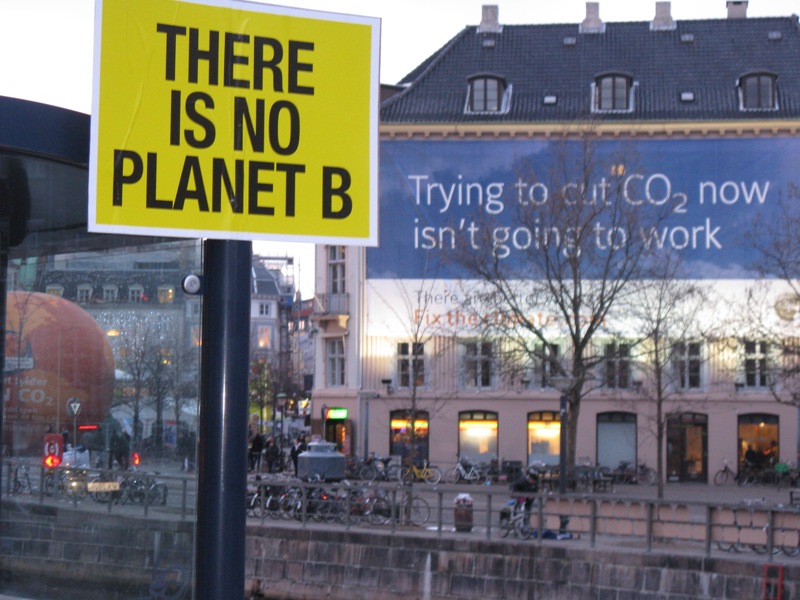
Even the notion that “There is no Planet B” does not seem to raise a political eyebrow. Suggestions, please . . . and soon!