Category: Human Condition

  • The Cult of the Anti-Personality

    The Cult of the Anti-Personality

    Houston, errr, no, America, we have a problem!

    The concept of the “cult of personality” has become well-known in the general public in recent years, having become a part of the “ordinary knowledge” of the average person, which means that when such cults are mentioned most people have at least a vague idea of what is being talked about. This is probably because such cults, whether positive or negative, have emerged in every walk of life—politics, economics, religion, music, culture, science, and even in industry—for decades or even centuries.

    Some cults emerge from society without outside manipulation. Others are manufactured top-down for ‘branding’ purposes by those who want to be at the center of a cult. Doubtless, psychologists have published books exposing this or that theory on such cults of personality. Sadly, I am ignorant of those writings, though my lifetime has been awash with media references to this or that personality cult. Examples abound.

    China’s Mao Tse-Tung was the center of a personality cult as was Zimbabwe’s President Mugabe. Kim Jong Il of North Korea was, too. Elvis Presley also had a cult of personality—though dead for almost thirty-five years, his cult still lives on! Ross Perot was the center of a political cult and movement in the 1990s, and today Sarah Palin, too, is a cult figure to at least a small segment of American society.

    As cult figures, their followers unquestioningly follow them, suggesting a “follow the leader” mentality among the members of such cults and, because of their dynamics, most likely a lemming-like attitude of “my leader, right or wrong.”

    The term ‘cult’ can be seen in either a negative or a positive light, though most often it is used negatively by those who oppose such cult personalities. Cult suggests something secretive, isolated, and even nefarious.

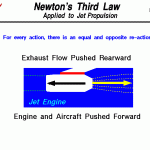
    Newton’s Third Law of Motion (1687) states that “for every action there is an equal and opposite reaction.” I believe that there is a social equivalent to this law. By this, I mean that for each cult of personality there is likely to be an opposing “cult of anti-personality,” at least this is what seems to have happened in contemporary US politics in the last few decades. Such an equivalent cult-type may have always existed.

    Recent US presidential elections, especially since 1980, illustrate what I mean by such negative cults. Anti-personality cults are driven now more by ad hominem dislike or excessive incredulity than by reasoned disagreement. And they have grown in number and intensity in the past two decades, having become increasingly more vociferous, unbending, and intransigent in their opposition to the cult of the political personality.

    One example is the personal attacks of a cult of anti-personality (and anti-greens) against former US Vice President Al Gore. Today, anything Gore says, regardless of content, is immediately attacked by this virtual cult. Scientific facts noted by Gore, for example, are continuously challenged, and his reasoning and even his facts being distorted even though those cult member(s) responsible for such distortion know what Gore’s message meant and knew as well the validity of the “science” behind his statements.
    George W. Bush was both a cult and an anti-cult figure.

    Obama is now the focal point of a significant cult of anti-personality. Attacks on him have been steady in flow and increasingly angry and hostile in content. Radio talk show hosts on the extreme right of the political spectrum are among the worst perpetrators of the anti-personality cult, whether for alleged entertainment value or for other psychological reasons (Obama is the first black president… and then there are the “birthers” who in all futility continue to question his citizenship status, even though the national media have produced the legal documents). They continue to foster unreasonable hatred for the sitting president as well as for the presidency itself.

    When I was a kid, it was an honor to listen to a President telling us to study and to work hard to become good citizens. Now, to hear a talk by Obama, various schools require permission slips from parents to let their kids listen to the President telling them to study hard and to stay in school. This current situation is unreasonable.

    And radio “personalities” like Glen Beck, Mike Savage, and Rush Limbaugh have continued to raise the intensity of their derogatory comments about the president and the presidency, angry distorted interpretations that I have not heard before. I don’t know if these millionaire radio personalities can see that their hatred of the sitting president is undermining the faith of their listeners in the American political system that they claim so vehemently to defend.

    Such anti-personality cult figures, from both the political right and the left, prompt strong negative (more correctly, hostile) reactions from those who, for whatever the reason, just don’t like them … and never will like them. Nothing, and especially not “facts” contrary to what they already believe, will ever alter the negative opinions of these people, especially in these times of modern media when the effects of group polarization push people to only pay attention to news outlets and sites that uphold the correctness of their own unreasonable opinions, encouraging them to become even more extreme in their positions. There is nothing positive to be found in a “cult of the anti-personality” because objectively innovative ideas are automatically ridiculed and rejected.

    I am not immune from feeling this way toward the current politicians in the US Congress who failed to challenge many of President Bush’s controversial policies, including deadly and costly wars on two fronts.

    Sadly, there is a third war underway and it is in the USA between political ideologies. This domestic guerrilla war has fostered a polarization of political parties that have fallen into voting as blocks (to support the other political party is viewed as disloyal to party principles and, to those on the right end of the political spectrum, as even being unpatriotic). At present we seem to have a party of proposers of legislation and a party of “opposers,” people who oppose willy-nilly anything proposed by President Obama. Some opposing congresspersons have proudly admitted to the public that they hadady opposed Obama’s programs that they never even read.

    This behavior reminds me of an adage from the Revolutionary War era, taught to us as school kids: “United we stand. Divided we fall.” It seems that the three branches of government as well as the 50 States have forgotten this guiding American polity’s rule of thumb. In my view the cult of the anti-personality—here I am referring specifically to ideology-based block opposition to anything proposed by President Obama—is destroying the country, turning people against each other in very hostile and potentially violent ways. There is a third-front war going on—and it is inside America.
  • Down with Earth Day! Up with Earth Year!

    Down with Earth Day! Up with Earth Year!

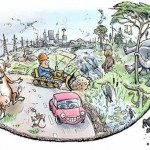
    For the past 53 years people have celebrated an Earth Day. Its beginning years were extremely valuable and eventful. Before the first official Earth Day in 1969, we were slowly emerging out of what might be called the dark ages of environmentalism; but, the decades preceding 1970 witnessed little concerted interest either nationally or globally in saving Planet Earth from the destructive ways of its human inhabitants.


    In the old days habitats were destroyed in the name of survival or out of a desire to create something that was viewed as a necessity or out of greed to convert a landscape or water resource into something that would generate a profit.

    Decades later after the first Earth Day, we can say with confidence that we (civil societies worldwide) have come to look at Planet Earth in a new way. Perhaps it was prompted by the satellite photo of our Planet Earth floating in space against a black universe — an inhabited “Blue Marble:” quite isolated, quite alone. That image from the late 1960s gave us the feeling that we had better not “foul our nest” or, to use another analogy, we had better work together to keep the Earth-as-a-lifeboat from sinking.

    Much has happened since the first Earth Day. The level of consciousness of the people, of government leaders, and of many industries has risen to the point where the environment enters into our everyday decision-making.

    So, now we look forward to Earth Day, which comes around but once a year (like Christmas or Independence Day). It is on our minds (and in the media) for a few weeks before and after. But, for the rest of the year, most people go back to thinking about other things and only occasionally about the fate of the planet.

    Thus, my modest proposal: A plot to save the planet

    We are in the first decades of the rest of the 21st century. What we decide today about whether or how to save the planet from wanton destruction will affect people born throughout the rest of this century. It is kind of awesome when you stop to think that many of the chemicals we put into the air and the water will accumulate there for decades if not centuries.

    Most people and governments are celebrating Earth Day once again in the year 2011. Parties, extravaganzas, gala events, teach-ins and countdowns are taking place around the globe. That’s nice BUT I suggest that we forget about celebrating Earth Day in 2012. Yes, forget it. Instead, let’s make the whole year of 2012 The EARTH YEAR. 2012 is also a major Earth summit of leaders from around the world called RIO+20, the 20th year after the Earth Summit in Rio de Janeiro, Brazil.

    Let’s use all of 2012 to focus on cleaning up the water, the land and the atmosphere for the benefit of present and future generations. Let’s give our descendants the best and cleanest planet possible. We can start now, just as if we were getting ready for Earth Day, but instead we would be preparing for a much larger endeavor, an Earth YEAR. Who knows, maybe it will catch on and each year will become an Earth Year.

    Earth Day, to many, serves as a feel-good day. But we can do a lot better. It is a challenging goal especially for those born after, say 1985, who are part of the eco-generation: they have been immersed in hearing about human abuses of the environment. They are the decision makers of tomorrow.

  • Putting Environmental Impacts Labels on Clothing

    Putting Environmental Impacts Labels on Clothing

    …But what about a Humans Rights label?

    The Russian fable of Potemkin Village tells the story of a village leader who, wanting to impress the Tsar, ordered that the fronts of all the buildings that faced the main street of the village be made to look fresh and new.

    In reality, however, despite these façades, the buildings of the village were crumbling and decrepit, though the leader was pleased because the Tsar and his entourage could not see them. The village leader was congratulated by the Tsar, and his standing in the empire was duly enhanced by the conceit.

    A few days ago I read an article in the Financial Times entitled, “Clothing companies in push for eco-impact labeling.” The article was about a new initiative of some “clothing and footwear manufacturers and retailers” to sew into new clothing and shoes a label stating the environmental impacts of the manufacture and sale of each article of clothing. It noted that “companies backing the scheme include, among others, Wal-mart, The Gap, JCPenney, Levi Strauss, Nike, Marks & Spencer, and Adidas.” Such labeling, which would address the manufacturing impacts on, for example, deforestation, greenhouse gas emissions, and chemical contamination through the release of toxins into rivers or groundwater, would provide consumers with immediate information about the ecological footprint of each item of new clothing they might choose to purchase.

    When I first read the article, I was actually happy that such an initiative was being seriously considered. I was unsure if it was just a marketing ploy by corporations to entice consumers to buy their goods because their manufacture would seem ”greener,” but I also thought that just maybe it was part of a sincere corporate plot to save the planet from the undeniable and wanton sullying of the environment by the processes of industrial production.

    Then, a sense of reality crept into my thoughts. Corporations today are often engaged in “greenwashing.” Greenwashing is when a corporation or government initiates a project or a program that makes it appear, on the surface, to be concerned with protecting the environment but is typically only just a “look good, feel good” façade. Corporations have engaged in similar forms of ‘washing’ for years, such as when they put a happy face on the working conditions in which their products had been made.

    There are so many examples, but so little space to write about them here. Nike, a company vilified only a few years ago for its exploitation of laborers, is apparently one of the leaders of the new environmental labeling initiative. Even enlightened Apple Inc. has recently been accused of allowing oppressive working conditions in its iPad factory in China (see the March issue of WIRED magazine).

    Also recently, Mexican children were ‘employed’ in factories to apply glue with addictive properties in the manufacture of well-branded shoes. The problem is that once such conditions have been exposed, we, the consumer public, assume that these are just rogue companies (or just rogue managers) and that such exploitations were corrected through either public outcry and boycott of corporate goods or by government regulation. But these are in no way isolated incidents. The reality is that such manufacturing circumstances are ubiquitous around the world, including in exploitive working environments in the United States.

    What I would like to see on clothing labels are statements that inform consumers about the life-conditions of workers who made the garments. What were their ages? Was child labor involved? What was their health status? What were their working conditions (sweatshop or not; working with dangerous chemicals or not)? What were their wages and average hours of work per day?

    Positive public responses to such labor information on labels might even spark positive environmental conditions as well. I am hopeful that such clothing and footwear labels would not prove to be little more than a corporate analogy of a Potemkin Village.

  • Guest Editorial: From Blind Copying (bcc) to Basics (abc) in Science. -Ilan Kelman, CICERO, Oslo

    Guest Editorial: From Blind Copying (bcc) to Basics (abc) in Science. -Ilan Kelman, CICERO, Oslo

    Author: Ilan Kelman

    Science has become mired in blindness; it is dominated by bcc representing “blind copying”. That is, blindly copying what has gone before without innovative thought. In science today, bcc means Bureaucracy, Corporatism, and Conservatism.

    Bureaucracy: Science is being bogged down in interminable reporting, complicated paperwork systems, and paperwork for paperwork’s sake. Rather than scientists, senior researchers are morphing into bureaucrats. That does not mean reducing accountability or project management. Those are feasible without snowing people under with paper and checklists. Science is becoming increasingly bureaucratic without any increase in accountability.

    Corporatism: Political leaders are heard today claiming that all money invested in science must have a business payback. Scientists are pummelled with corporatespeak such as visions, stretch goals, identities, and objectives. Those are useful approaches for structuring thoughts in certain contexts. They cannot apply to all contexts, especially exploratory research where the pathways and outcomes are not known–cannot be known–beforehand. If all research pathways and outcomes were known in advance, then we would not need research.

    Conservatism: Increasing expectations from science focus on outputs, such as counting the number of peer reviewed papers and ticking off the list of deliverables. Any attempt to take a risk is discouraged because, heaven forbid, results might not be publishable. New case studies can be nixed because it is not known what is there–which is precisely why those case studies should be researched. A culture of fear prevails that we might actually learn something different from what we expected in the first place.

    How could the bcc situation improve? We must move from the bcc of blind copying to the “back to basics” of abc. What is the basic purpose of science? To search for explanations and to gain knowledge. abc achieves that through Action, Boldness, and Curiosity.

    Action: Much of science plods along, week to week, hoping for a breakthrough or to find something publishable. That should not preclude excitement, dynamism, and acting on desires to know and learn more. No punishment should exist for taking action to pursue a query where potential exists for important results, even if that means deviating from the original plan or using the assigned budget for other activities. Note that action does not necessarily mean activism. The action can be along the lines of simple scientific enquiry, following a lead that appeared even if not listed in the initial project plan.

    Boldness: Science should not be afraid to take risks. Risking a project or part of a budget on a daring move, an odd case study, or a unique situation has the potential for immense gains. Even if 99% of bold decisions to strike out in new directions fail, the 1% success rate will pay back dividends that are orders of magnitude greater than the expense. The evidence? The transistor. The discovery of pulsars. The proof of the CFC-induced ozone hole. Amongst many others.

    Curiosity: Scientists these days frequently seem scared to ask deep questions. For example, challenge a leading scientist in climate change to prove assertions made and the consequence can be ostracism from the clique along with personal attacks. Dare to pursue a topic because it interests you and the consequence is being hauled before bureaucratic superiors to justify your use of time and budget. Try to shift a budget line to take advantage of recent developments and the consequence is being labelled a troublemaker by the granting agency who must use time (and hence money) to determine whether or not to approve such a small change. Investigation for “sheer curiosity”–just because it is there–is frowned upon. What is the point of research if we cannot follow the tendrils of our minds?

    Science is being killed by blind copying. We are losing creativity and innovation. Society loses in the long-run by having fewer explanations and less knowledge to apply for a better world. Where are the scientific visionaries and leaders today who can bring science back to life–back to basics?

  • “On Retiring the Concept of Retirement.” Mickey Glantz. written in Tokyo, in Starbucks while on travel (May 18, 2010)

    The term retirement, despite its definition is apparently reserved for the aged not the young because the young are, expected to go on to another job. But then what is the definition of work or a job? Is tennis a job? Is writing a job? Is travel? Is writing a memoir for example, a job? Is reading all these books you bought but never had a chance to read a job? I think so.retirement_gifts-image-joy-of-not-working

    I’m 70 now and I am thinking a lot about what it means to retire. In the old days — the 1960s when I first entered the workforce — retirement was a goal: get to 65 and stop working at whatever you had been doing for the past several decades. The idea then was to retire, sleep late, and sit on a porch somewhere watching sunrise and sunset, day after day after day. Wait a minute: Already, this is starting to sound boring.

    Turning 65 meant that you had to close down your social network at the place of employment. Yet, to many, co-workers had become a surrogate family, and the workplace had become a place to go, to hang out, to share stories, to chat. Your workspace was much more than a few square yards of floor space, a desk, a phone, a fax, a bubbler; the workplace was a social happening, for good or bad. Most likely many workers are in the presence of co-workers over time spans longer than with their spouse and kids.

    Societies and governments compartmentalize our lives. The education system is the best example: pre-school, kindergarten, elementary, middle, high school, college and then maybe graduate school and finally the workplace (it is age-based). Society, however, has a new concept that parallels, while at the same time challenges the traditional age-based, cohort-based, boxed-in educational framework: K to grey (Kindergarten to the elderly). Education is now recognized worldwide as a life long experience for those who wish to see it that way. However, society has not yet come up with an equivalent parallel, time-independent concept for one’s worklife.

    Whatever their specific reason, people today continue to be active well after the previously established expected retirement age of 65. The word “retirement” has become at best a poor descriptor of what now happens.

    First of all most people have more than one job in their lifetime and many have more than one job at the same time (not necessarily by choice!). But we don’t say s/he “retired” at 30 (to start another career). We say, instead, they took another job, quit, dropped out, moved on, etc. “Retirement”, the concept seems to be reserved for one’s post-worklife life. But in today’s financial or social environment the end of work life has become synonymous with the end of life.

    Retirement as a concept has lost its original meaning. People are busy all their lives, working at something, even if that “work” is in the form of play.
    retirement_is_a_fulltime_job

    It is quite clear to me that the concept of “retirement” needs to be retired, much as sports organizations retire the numbers that star players have worn on their shirts for baseball or football. We do not retire any more. We just change from one activity to another, just like the young people as they do when they go from one job to the next.

    Like I said at the outset, I’m 70 now and just beginning.

  • Solving America’s Health Care problems in one easy step! Mickey Glantz, March 1, 2010

    Solving America’s Health Care problems in one easy step! Mickey Glantz, March 1, 2010

    The country is so polarized on just about every issue and health care is no exception. A year passed and Obama’s Administration devised a plan that some like and some despise. The opponents of the president’s plan call for starting the process all over; forget what’s been discussed so far. The supporters of his plan are calling for pushing through health care reform without kowtowing to the Republican opposition. There is no other solution that can overcome the political polarization that exists in the USA today.

    The American Public signs a petition demanding that people in hte general population get the same health insurance coverage and premiums that the members of the US Congress presently enjoy. If it is good enough for Congress persons, it should be good enough for the people who elect them.

    Access to Cheap Health Insurance and Care is a Congressional Right but not a Public Right, according to the US Congress Senators and Representatives.
    Access to Cheap Health Insurance and Care is a Congressional Right but not a Public Right.

    Alternatively, we could also petition that Congressional representatives receive no special coverage from the US Government and have to shop for health insurance coverage like their constituents.

    How about starting a national campaign to gather signatures on a petition to send to Congress, Senators and Representatives alike.

  • “Haiti Cherie says Haiti is my Beloved Land. Oh, I never knew that I have to leave it to understand…” Mickey Glantz. January 14, 2010

    I was introduced to the song “Haiti Cherie” on a Harry Belafonte album released in 1957, the year I graduated high school and then entered university as a beanie-wearing freshman. The song, the whole album in fact, turned out to soothe the ruffled feathers of a naive young boy starting the rest of his life away from the security of the family nest. belafonte

    The deadly devastating earthquake of January 12, 2010, brought to mind Belafonte’s various songs of the Caribbean and especially Haiti Cherie. I have long been interested in Haiti though I have never visited the country. Its history has been in some instances interesting and in other instances sad. In the early 1800s (1802 actually) the black leader (later, King) Christophe overthrew French rule on Haiti’s half of the island of Hispanolachristophe-easton-102

    (Yesterday, in his infinite stupidity, Reverend Pat Robertson referred to this independence from France as “Haiti having made a pact with the devil 200 years ago” and that was the reason for the earthquake).

    When I was growing up, Haiti was plagued by the rule of Papa Doc Duvalier and his army of thugs—the Tonton Macoute—that kept the people under control through unfathomable horror tactics. Duvalier’s son, Baby Doc, followed his father’s rule and also relied on the support and protection of the Tonton Macoute, but the island’s economy was already in shambles. All demographics about the country were abysmal.
    papadocbabydoc

    They ruled with an iron fist and fear of voodoo
    They ruled with an iron fist and fear of voodoo

    I learned early on that Haiti was the poorest country in the Western Hemisphere. I also learned that in the 1960s it was receiving the most U.S. aid per capita in the Western Hemisphere, most likely because of its proximity to Castro’s communist Cuba. I have to assume that a lot of that assistance went to the military and to corrupt government officials. Then, Haiti was poor, undernourished, mostly illiterate, and the poor were living in such squalor and amid degradation that it would’ve been generous to call their habitats slums or shantytowns. But, somehow, the poor of Haiti managed to survive.

    I also recall hearing about Haitian immigrants seeking refuge in America on overloaded boats and small crafts, even inner tubes, on the hopes of getting to the Florida coast, much as their Cuban neighbors had done. The difference is that the Haitians were sent back home, allegedly because they were not political refugees as the Cubans claimed but because they were labeled as economic refugees. Cubans could stay; Haitians had to go.

    Haitian boat refugees seeking a better life in America
    Haitian boat refugees seeking a better life in America

    Fast forward to the stories now unraveling about the deaths, suffering and devastation of the people on one of the poorest nations on the earth. Countries and groups that were before unconcerned about the poverty of Haitians are now pouring out their hearts, souls and funds to somehow help the people of Haiti in their moment of need. It is likely the wrong time for me to bring up the fact that all governments knew of Haiti’s poverty—of women feeding kids salt-flavored clay wafers to fill their bellies with anything that could ward off hunger pains, of Haiti’s chronic hunger, of Haiti’s treatable water-borne illnesses, of Haiti’s squalor in its settlements, that the productive land surface of the country has vanished, that the Haitian population is illiterate by half and unemployed by three-fourths.

    What we are witnessing in this global reaction to Haiti’s earthquake is a human response to a cataclysmic event: Sympathy, empathy in some cases, a desire to help Haitians in any way in their moment of dire need. All of the ingredients for a crisis had been visible for all to see.

    msf: doctors without borders, Haiti
    msf: doctors without borders, Haiti

    Many non-governmental organizations and aid agencies have been for years engaged in trying to bring Haitians a better life. However, the big money, either from governments bilaterally or international aid agencies multilaterally, was not enough to even scratch the surface of Haiti’s numerous problems or was provided in uncoordinated ways that did not help the country become self sustaining. Haiti was neglected in the past, and if other complex humanitarian crises are any indicator of what is to follow in a year or two or three, Haiti will be neglected in the future.

    Is there a concentrated effort equivalent to what went into the “Manhattan Project” that could be sparked by the current sad plight of the Haitian people that could help the Country surpass a tipping point that would enable it to provide a good, productive and healthy life for its citizens? There must be. Why can’t rich countries tandem with one of the poorest to bring its standard of living up? Why is it so easy to find money for a war or money for a disaster but not for attempts to improve the vulnerability of the lives and livelihoods of the poor?
    The optimist in me says it can be done if the will of governments exists to do it. The cynic in me suggests that the dark side of human nature —greed, corruption, self-interest —will likely rule the day. Maybe the upcoming younger generation of policy makers can show my generation why and how the dark side must be changed or contained.

    The bottom line is as follows: Who has responsibility for the well-being of people living in countries in the Fourth World?

    Donations to assist organizations working in Haiti’s relief efforts can be made through the Clinton Foundation. http://www.clintonfoundation.org/haitiearthquake/clintonfoundation

  • Limbaugh, lemmings and the “Oxycodone ate my brain” line of defense

    Limbaugh, lemmings and the “Oxycodone ate my brain” line of defense

    Limbaugh, lemmings and the “Oxycodone ate my brain” line of defense

    Mickey Glantz
    FRAGILECOLOGIES

    October 22, 2009

    I am ashamed on behalf of rational America of Rush Limbaugh’s lack of civility. He suggested on air that a New York Times journalist should kill himself. In the same vein as not being able to yell “fire in a theater” a talk show blowhard should not be able to call for the death of anyone because there are nutcase followers who are hanging on Limbaugh’s every thought, however crazy and ill-conceived those thoughts might be. Seems like Oxycodone still rules Rush’s brain. And to the FCC, bring civility back to the talk show hosts on radio and TV.

    Limbaugh to me is like a fly in the proverbial ointment. He is there and you figure out how to either ignore it or get rid of it. I choose to ignore it/him. Blowhards are just that, blowhards. They say things that are outlandish or outrageous as a call for attention. His latest skirmish with reality (which is so weird) is Limbaugh’s public suggestion to New York Times science writer Andy Revkin, that Revkin should “kill himself “ as a gesture to save the planet from human activity. That sounds like an American-grown “fatwa”, this coming from an alleged spokesman for the Republican Party who claims to be so anti-jihadist. [NB: according to “About.com:Islam”, The people who pronounce these rulings are supposed to be knowledgable, and base their rulings in knowledge and wisdom]. Ooops. that does not seem to have been the case here!!

    Limbaugh’s fatwa on Revkn is reminiscent and more extreme than the right wing view that “if you don’t love America, then you should leave it” {which really means if you don’t agree with the right wing then leave the country}. I can see the bumper sticker now that will adorn Hummers and other gas-guzzling cars, “Love the Planet or Leave it”. So much for the image of America’s tolerance of opposing views. fatwa

    But could it be just a play by Limbaugh for higher media ratings? Should he get a free ride with those who oversee the media? Did he cross a line of civility with regard to the use of the public airwaves? Is Limbaugh our generation’s Father Coughlin [the 1930s leader of the anti-Semitic Christian Front]?

    His latest outrage leads me to believe that Limbaugh’s dependence on narcotics (Oxycodone, among other illegally gained drugs of his choice] to get him through his day a few years ago has had an impact on his ability to think rationally about what will come out of his mouth on the public airwaves. Are his inner thoughts tripping off his tongue before he can edit them?

    He has a following , many are acting like political lemmings; no need to think for oneself just that believes everything Limbaugh utters. It is not much different than calling for assassination on the airwaves. His personal attacks on Revkin are unwarranted, ill conceived and only serve to divide the country rather than to bridge the difference.

    Limbaugh should be reprimanded for his stupidity and if it really is the case that the drugs have cooked his brain then let’s do the humanitarian thing and get him some psychological help.

  • A message to Iran’s government from a nobody

    I have been watching with interest and sadness the current political election crisis in Iran. It is a crisis the government has brought on itself and the country. It energized the students in the name of a faux-democratic election. The government had no intention to allow an opposition party to take control. So, it came up with unbelievable numbers for president Amenidijad’s alleged victory. Not only that, but the results were announced within a few hours of the polls having closed (millions of paper ballots were counted in no time at all!!!).

    The country’s supreme leader Khameni sided with Amenidjad and called for crushing the opposition. He and the rest of the government are busy blocking international electronic transmissions of photos, videos and text and busy blaming everyone for the street protests, everyone but the true source of the crisis: the current Iranian regime.

    I sympathize and empathize with the people in the streets, yearning for a democracy and their human and political rights. Iran’s political progress has been set back to (really, exposed as) a dictatorship. The Iranian students and other people from all walks of life who oppose the repressive government have been let out of Pandora’s Box. Maybe the people can be repressed again as in past revolts since 1979, but the government will now have exposed what it really is, a repressive oligarchy, the rule of a relatively few for the benefit of that few.

    Why am I prompted to write now? I watch a young martyr die in the street in her father’s arms. Neda is her name. She is dead but I say “is her name” not “was her name” because her spirit and fight for freedom on behalf of her countrymen lives on. She was shot by a government sniper. There was a video taken of her being shot and then dying. It was a horrible image to watch but Neda to me is the symbol of the revolution that is underway.

    Surely, sanctions on the Iranian government will follow and Iran will become further isolated from the community of nations. Amenidijad will continue to represent a crazed element of the government. One can only hope that he will be replaced by a more rational politician in the not so distant future.

    The following phrase on the Internet sums it up: “Khameni and Amenidijad are the enemies of their people. Even the Shah of Iran did not order his police to shoot.”

    Iran’s theocracy is unraveling. Stay tuned.

    mickey glantz

  • “End Run Wars” are not only for the weak, OR Know your enemies before you act!

    Mickey Glantz in Tokyo

    22 May 2009

    “End Run Wars” are not only for the weak, OR Know your enemies before you act!

    When I was in graduate school back in the second half of the 1960s, the heart of the Cold War rivalry between the USA and the USSR, I took several classes on conflict. The conflicts that captured my attention were hot conflicts, wars particularly, and especially revolutionary wars. Such wars at that time were being carried out by political, cultural or ideological groups wanting to gain independence from the control of a larger hegemon whom they felt did not care for the well being of the people they claimed to represent.

    At that time certain books were fairly prominent, but at least to a graduate student the writings of his or her professor took on an added value (such as higher grades for citing their works in an essay exam in addition to the value of the usable information within the books). One title that I recall that had a lasting influence on me apparently was a book by Dr. Robert Strausz-Hupe entitled “Protracted Conflict”. I recently perused the book in order to see if more than the title was still relevant to an enhanced understanding of today’s post Cold War conflicts. Many of the writings before 2000 seem to be lost among young researchers today as they were written “in the last century” and there is a feeling (I suffer from it too) that if the publication was not done after the turn of the millennium than there must be better, more current and more relevant stuff written today. Of course this is a dumb assumption, given that by now we are likely to be reading the latest book’s summaries of summaries of original works. In other words, as a result of this process we are highly likely to be losing information, as each summarizer is like a filter that sifts out what he or she feels is relevant for access by future readers.

    The truth is that I did not re-read “Protracted Conflict” closely but I felt it did not really have a lot of direct relevance to an improved understanding of today’s conflicts, like the ones in Iraq and in Afghanistan. So, I went to the Internet to search for a definition of a concept I heard somewhere in those Dark Ages of graduate school. The concept — an end run war — has been popping into my mind of late, and I am not sure why. So today, in a Tokyo Starbuck’s I could not find commentary on end run wars. So, now I have to wing it (lest I be forced, oh no!!! to go to a gasp, real library and do old-fashioned search).

    As I recall the concept of an end run war, it was a war started by a weaker power who perceived that the stronger power was involved in some sort of quagmire — political, financial, military — and that it would be a good time to attack in order to gain some long sought after gain. That is what I recall as being an end run war. While perhaps successful at the outset, over time the weaker power tends to show up as just that, weaker, and the early gains on the battlefield are reversed as the major power regains its focus and rallies to pushback, if not overrun, the weaker power that attacked it.

    Fast forward now to the present: Looking back at the origins of the Bush invasion of Iraq in 2003 and the attempt to topple Saddam Hussein from power, one could argue that the US-Iraq war was an end run war precipitated by a strong power in the belief that the weaker power would collapse. All signs looked that way as US troops (or the troops of the so-called “coalition of the willing”) made their way so quickly to Baghdad with little military opposition. It appeared and was presented to the public that Hussein’s army had collapsed in short order. Of course, that led to the premature disastrous and embarrassing ‘photo-opportunity’ by President Bush’s “Mission Accomplished” staged event on a US carrier. And then the real war began. The infusion of foreign fighters joining Al-Queda, local dissidents, abandoned army and police members, rivaling ethnic groups caused a military backlash against the allies that converted what seemed like a quick-victory end run war and into a 6-year nightmare for the US President, his administration, the Republican Party (and fellow-traveling Democrats) and the American and Iraqi people.

    Now we have a new president, He has inherited the falling out of the worst outcomes of what was to have been a successful end run war. While the war effort in Iraq winds down and the US government tries to put a happy face on it as it prepares to leave in the next couple years, that smiley face will begin to frown as the US troops are not sent home to American soil but into harm’s way in Afghanistan to fight the growing number of Taliban who in the last few months have spilled into neighboring parts of Pakistan. The region is in turmoil with Iran emerging as a regional superpower, Iraq unstable and a war in Afghanistan that is increasingly intractable.

    It seems that end run wars regardless of whether weak attack strong or strong attacks weak, victory is not so assured for the perpetrators. Wars as we now are reminded are often easier to start than to finish. The escalating engagement in Afghanistan will be no different.