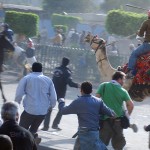
“What’s the Fuss now?: The international community tolerated Mubarak for 30 years.”
Mickey Glantz, February 4, 2011
To read the news today either electronically or through printed media you’d think Hosni Mubarak changed from a Dr. Jekyll to a Mr. Hyde. You would think that something bit him while he was sleeping and when he awoke he had been transformed into a horrible dictator. The truth is that he has been a dictator for much of his 30-year rule. The relative voicelessness of Egyptians within the country about his dictatorial rule.
(despite supposed democratic elections to the presidency) is understandable. Dictators stay in power through a rule of terror by using police and thugs to keep the people intimidated, quiet and powerless.
What is not so understandable is the 30 years of silence by those governments that worked quietly with and alongside Mubarak’s regime for whatever reasons of state. US does not stand alone in this regard. So, Americans on the Left and on the Right of the political continuum are speaking out against or for American involvement in the Egyptian Revolution. The raving Left (and I am a bleeding heart liberal for the most part) wants Mubarak out today yet they were, for the most part, silent for decades about his rule. The raving political Right blames President Obama for not getting more involved verbally in the Egyptian revolution by calling for support for Mubarak. Both sides point out good arguments to support their views. But that is not my point.
My point is that the silence of 30 years of dictatorial rule
 in the name of democracy was deafening in retrospect. It was as deafening as is the cries of a million Egyptians demanding that Mubarak abandon his presidency today. The people want him out and out he must go. But what about the scores of dictators running countries not only in the Middle East and North Africa but also around the globe? Will there be demands from the Right and the Left to depose them? Will they demand that their governments take actions to support the aspirations of the people for well-being, freedom and true democracy in their countries?
Zimbabwe, Congo, Eritrea, Moldova, North Korea and Myanmar stand out as prominent examples of similar governments to target. There are more of them.
It won’t happen for reasons we can guess. The one ‘excuse’ for their non-involvement (silence, that is) is the old rule of “non-interference in the internal affairs of member states.”
Q: Mr. Secretary [of Defense, USA] did you speak with the President about the detention of political leaders in this country, the closure of the private press and how it will influence the relationship between your two countries?Answer by Rumsfeld (2002): “You know, yes the subject came up, we discussed it and the ambassador has discussed the issue and issues of that type. All across the globe and a country is a sovereign nation

and they arrange themselves and deal with their problems in ways that they feel are appropriate to them. By the same token, other countries looking at how those arrangements are make their judgments as to how they feel about it and how they can interact with such countries. And it’s a very straightforward discussion and I think there’s clarity on both sides. And we are personally hoping that the relationship will evolve and strengthen and grow in the weeks and months and years ahead.”
{Source: Secretary Rumsfeld Press Availability In Eritrea, Tuesday, December 10, 2002,
http://www.defense.gov/transcripts/transcript.aspx?transcriptid=2855}
The truth is that UN Charter rule of thumb is used as an excuse to take no action where action is likely warranted. However, that rule has also been put aside, when national interests of other countries were perceived to be adversely affected, politically, financially and sometimes (but not so often) because of humanitarian reasons. Maybe, in the age of globalization, where every country is in every other country’s face, the rule of not speaking out against bad governments has to be scrapped. With globalization of media (TV, Google, Facebook, Twitter and other social networks), there is no longer any place that dictatorial rule (bad governments, corrupt governments) can hide.
Today in Tunisia and in Egypt it became obvious to all that the proverbial emperors were wearing no democratic clothes. Will the fervor of these popular revolutions prove contagious to other parts of the globe — not just the Middle East and North Africa — to those people who have had no voice and to those on the Right and Left whose voices can influence the policies of their governments on behalf of the oppressed and voiceless people?

