
Tag: senators

  • Insight into the American Election Re-Cycle

    Insight into the American Election Re-Cycle

    I was listening to election results on the radio recently and a phrase caught my attention. The commentator said that the Iowa caucus in the first week of 2012 was the beginning of the 2012 election cycle. I hadn’t thought about it before but the phrase “election cycle” is accurate in one sense but is false and misleading in another sense.

    Every 2, 4 and 6 years there is an election in the US. The presidential election is on a 4-year cycle. A Representative in the US House of Representatives must stand for re-election every 2 years. And a Senator in the US Senate must stand for re-election every 6 years, but every two years one-third of the 100 Senators is involved in an election cycle. So, yes, there are election cycles.

    But let’s look at the elections in a different way.

    A Congressperson is up for an election every so often on a regular basis, hence the the name election cycle. But most of those Congress people, Representatives and Senators alike, are re-elected again and again and end up serving in the US Congress much longer than just one term in office. Here is are statistics about re-elections from the Internet :

    In November of 2004, 401 of the 435 sitting members of the U.S. House of Representatives sought reelection. Of those 401, all but five were reelected. In other words, incumbents seeking reelection to the House had a better than 99% success rate. In the U.S. Senate, only one incumbent seeking reelection was defeated. Twenty-five of twenty-six (96%) were reelected.

    My point is that what is actually happening before our eyes is so obvious that we, the electorate, don’t see it: that is, when we talk about the actual election process — putting people into elective office — we should refer to it as the “election re-cycle.” We are fooling ourselves to think otherwise. Incumbents have advantages over challengers: “perks in office, exposure via the media, campaign staff.” And they are in a position to gather much larger war chests for re-campaigning than are their challengers. Money is a major reason that a person elected to the US Congress tends to stay in Congress.

    So, let’s refer to the congressional elections process as an election re-cycle. That way the American public will know what it is doing when it votes. They are unthinkingly tethered voting for the incumbent. Not a very democratic process in my view.
  • US Congress and Climate Change

    US Congress and Climate Change

    – Proof Positive That American Education is Falling Behind

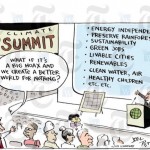
    Lately I’ve been wondering about how some US Congresspeople (senators and representatives) can still flatly deny the possibility that human activities are emitting gases that can heat up the temperature of the atmosphere. So many scientists around the globe have researched the global climate system as well as ecosystems worldwide and have come to a consensus that human activities are heating up the atmosphere. Yet, a few key senators and some likeminded congresspeople continue to block efforts at the local as well as federal level to deal with the global warming reality (note the emphasis is on global not national). The US is a major contributor of carbon dioxide emissions to the atmosphere, though China has recently surpassed the US in this regard.

    True, there is still a lot to learn about the interplay of climate, society and the environment. In scientific research there is always some degree of uncertainty. Nevertheless, evidence of worrisome changes in climate and in the impacts of those changes on ecosystems, if not yet on society, has been mounting especially in recent times. At first (from 1898 to the mid-1950s) a warming of the atmosphere was viewed as a good thing, because it would hold back the Ice Age that was likely awaiting its onset. But after 1956, the warming began to take on the image of a bad thing.

    The rest of the world scratches their collective heads over the lack of political interest in joining other nations to accept, let alone combat, global warming. Civil societies in distant lands, especially their youth truly concerned about global warming, watch the media in disbelief about a U.S. Congress that seems to be science-illiterate (examples are many. Here are two: attempts to reduce the involvement of the US Environmental Protection Agency in setting limits for greenhouse gas emissions or the attempt to strip NOAA of much of its early warning capabilities).

    People in America want to believe that America is a world leader today, as it had been in much of the 20th century. The reality is that it is not. According to the Alliance for Excellent Education (USA, 2008),

    “The United States ranks 21st of 30 OECD countries in scientific literacy, and the U.S. score of 489 fell below the OECD average of 500 (OECD 2007b). One quarter (24.4 percent) of U.S. fifteen-year-olds do not reach the baseline level of science achievement. This is the level at which students begin to demonstrate the science competencies that will enable them to use science and technology in life situations (OECD 2007b).”

    And America’s poor performance is not restricted to science alone. The Alliance also noted,

    “But as globalization has progressed, American educational progress has stagnated. Today, the United States’ high school graduation rate ranks near the bottom among developed nations belonging to the Organization for Economic Co-operation and Development (OECD). And on virtually every international assessment of academic proficiency, American secondary school students’ performance varies from mediocre to poor. Given that human capital is a prerequisite for success in the global economy, U.S. economic competitiveness is unsustainable with poorly prepared students feeding into the workforce.”

    To me many of our congresspeople are proof positive of that American decline in scientific understanding and reasoning. I sometimes wonder if they believe that the Earth is flat! They are also proof positive that the US Congress must increase its support to education at the k to 12-grade level, instead of being hell-bent to cutting that support.

    How then can we — The People — bring sense to a senator like Sensenbrenner or hope back to a senator like Inhofe? Through improved education a smarter, wiser public will lead to a smarter, wiser Congress (both Houses of Congress) and a better appreciation of the importance of educating Americans from “K to Grey.” Get Smart, Congress. Put aside your petty political ambitions and strengthen K to 12 education NOW. Don’t destroy American education in order to save it. that is a failed strategy.