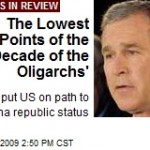

The three major stages of economic development are as follows: the primary sector, dependent on the exploitation and sale of primary resources such as forests and mineral resources; the secondary sector is based on manufacturing and the tertiary sector is based to a large extent on providing services. As noted elsewhere, the 1950s and 1960s saw discussion of the possibility of an emerging post-industrial society. Well, we are there now in America. In fact we seem to be nearing the end of it, in large measure as a result of outsourcing not only our manufacturing activities but now our services as well. My lament was captured in the question, “what happens in a post-service society such as ours? What’s next? Yesterday I did not know. Today I think I do. Tah Dah! An oligarchy.
America is well on its way to becoming a full-fledged oligarchy, that is the rule of a few for the benefit of a few. Here are some definitions of oligarchy.
1) a small group of people having control of a country, organization or institution; (2) a state governed by such a group; (3) a form of government in which all power is vested in a few persons or in a dominant class or clique; (4) power essentially rests with a small group.

It seems that the oligarchy becomes the “last social class still standing,” having weakened or destroyed the power, means and will of other classes in society. Media moguls, political party leaders, congresspeople, Fortune 1000 CEOs, and the like, hold sway over which laws get proposed, which laws are passed and which ones are rejected. The Supreme Court members as well are among the ruling elite.
A major difference between our oligarchy and those of earlier times in other places is that the American public is super-polarized now by political, economic and cultural ideologies. It has increasingly becoming a country of one-issue voters, who often end up voting against their own long-term personal and class interests. They are somehow convinced that all taxation is bad, even of the super-rich. They believe that public education is a waste of money, that religious schools should receive public monies, they believe they should be able to divert contributions from social security into the stock market despite the decadal market crashes. They support candidate of big business who support and foster outsourcing of American jobs. They support people who see corporations as deserving legal rights equal to those that people have. They seem to support lawmakers who so no to everything that a non-white president favors without having to give substantive arguments as to why.

We have become a nation of sheep. We follow whomever we think should be the leader. We oppose change out of ignorance. We do not understand issues that we vote on or people that we vote for. We take irrational stances on issues that directly affect the country’s and their own personal well being in the long run.
Sadly, it seems that America is well on the way to becoming a nation “of the oligarchs, by the oligarchs, and for the oligarchs.” The Golden Rule seems to prevail yet again: those with the gold make the rules…even in a so-called democracy. It is different today as well, for the Golden Rule is out of control of anyone, except the oligarchs, as they vote themselves laws forbidden that they be taxed. So many workers pay more taxes than do many a wealthy corporation (GE, EXXON, etc) or a CEO of a Fortune 500 company, thanks to Bush’s tax breaks for the rich.
NB: The Bush image is on www.newser.com
NB2: The medicare slogan underscores ignorance of some voters who do not realize Medicare IS a government program! Such signs have appeared at Tea Party rallies in the USA.

