Mexico is plagued (the correct choice of words. Another might be infested) with gangs that live and die by violence. While philosophers and economists have labored for centuries about how to put a monetary value on a human life, in Mexico today the value of life to any one of those drug-related gangs is but a few dollars, the cost of a bullet or two.
There is no line drawn between the guilty targets of one gang against a rival gang and innocent bystanders. It seems that the gangs are trying to intimidate their rival gangs by killing innocent bystanders in the area controlled by their rival gangs. When they can’t strike out at each other they strike out at innocent people. Anyone, anywhere — butcher, baker, candlestick maker — has become fair game in this Mexican style “proxy gang war.”
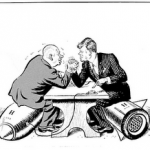
Proxy wars were common during the Cold War decades. The Soviet Union and the United States were engaged in an ideological do-or-die war of ideologies with each superpower backed up by its large and growing nuclear arsenal. But because both countries possessed nuclear weapons, they sought to avoid a heated conflict that could potentially escalate into a hot nuclear conflict. So, they resorted to the use of proxy combatants with each superpower supporting one or the other side in a conflict: north vs south Korea, north vs south Vietnam, east vs west Germany, Chang Kai Shek’s China vs Mao Tse Tung’s China, and so it went right up to the collapse of the Soviet Union in the early 1990s.
Much of the Cold War rhetoric was centered on terror tactics of which there were two types, one focused on force and the other focused on value. Force meant one country would threaten to strike at the army of the other: if you strike first, we will go after your military bases and other installations. The second type was based on value or threatening to strike back at non-military (soft) targets such as highly populated urban centers, if provoked. 
Strategies were then developed to counter such types and were called counterforce and countervalue, with follow up programs to harden the defense capabilities of urban areas as well as military establishments.
So, can the Cold War serve as an analogue to current situation in Mexico?
The situation in Mexico, as I see it, is one of a “proxy war” that is focused on value: that is, where rival drug gangs seek to intimidate each other by going after the public within the territory of its rival gang to expose vulnerabilities and the proverbial Achilles heel of the rival gang. The government is helpless and apparently hapless in protecting its citizens. It has no counter value strategy and cannot guarantee the safety of its citizens. 
The question then becomes, who needs a government that cannot protect it from hostile forces? Isn’t this one of the basic inalienable rights of citizens in their exchange for loyalty to the government, sort of an unwritten social contract between governed and governors?
What then is the government to do — business-as-usual by letting the rampant violence continue while protecting enclaves of the wealthy within the country? Or should it concede that the situation within its borders is out of its control and call for international assistance to go after the destabilizing gangs? 
To do nothing would be to allow for a situation like the one that exists far away in the heart of Africa, in the Congo in the heart of Africa to continue. A government that accepts the status quo — violence in areas out of its control, is accepting “anomie” a situation in which unstructured violence can prevail. [NB: ” French sociologist Emile Durkheim used the concept ‘anomie’ to talk about the dangers that people in modern societies experienced. He constructed this French word ‘anomie’ (meaning without ‘norms’ or social laws) to describe the dysfunctional aspects of modern societies.” (yahoo.com)]. Does this describe what is happening to our neighbor to the South?
America’s hands are not clean. Americans buy the drugs that those gangs illegally send North to us. In large measure Americans have a collective responsibility for what has happened to Mexico.
Is it too late to reverse the violence to the South or the drug use to the North? Only time will tell, but there is not a lot of time left to resolve this situation. Sometimes it makes me think of the movie “Mad Max.”
