
Tag: Egypt

  • Is too much sovereignty a bad thing?

    Is too much sovereignty a bad thing?

    …Take Libya, for Example

    The concept of sovereignty has been around for centuries and has taken twists and turns in its meaning. But today I believe it is defined most plainly as ultimate decision-making power, political “overness” or control of everything with a country’s borders. Sovereignty, in different places at different times, has rested with absolute rulers, constitutional monarchs, legislatures or the people (at least in theory). Sometimes implicitly and sometimes explicitly, the ‘rule of thumb’ of a definition for sovereignty is that decision-making authority within a defined political realm is free from outside interference.

    Leviathan

    In my mind, sovereignty has been given a free ride as a concept. It is on the order of the sacrosanct, like religious leaders and motherhood and national flags, things or ideas that are generally considered off limits for open, honest, and frank discussion or criticism. To question sovereignty in one’s own country is to be perceived as unpatriotic. To question the sovereignty of another country is to be imperialistic or meddling, depending on motivation. In fact, recognition and acceptance of the sovereignty of other nation-states is a cornerstone of the UN Charter. “To each his/her own” is the defining rule. Without the cornerstone of sovereignty, there would be no internationally chartered authority, even though that same cornerstone also ensures that a government can do most anything it wants within its own borders, even imprison its people (Myanmar), starve its people (North Korea), cheat its people (Congo, Egypt and a long list of countries—developed and developing—much too long to put here) or rule through fear of death or imprisonment (Iraq, Iran, Libya, Zimbabwe—again, the list goes on and on). We read about such examples from around the world in the news every day, especially recently.

    Only a few weeks ago, the government of Tunisia, neglecting cries for reforms from its citizenry, was toppled. Then fell Mubarak in Egypt. Yemen and Oman are now under pressure, and today the bloodiest uprising is ongoing in the terrible and deteriorating situation in Libya. Several leaders in other countries in North Africa and in the Middle East are now seeking reforms that have been long desired, long neglected, and long in coming. In hopes of saving their regimes, reforms are being discussed and/or implemented at lightening speed in places like Saudi Arabia, where the absolute monarch has offered his subjects a reform carrot of $35 billion for various public benefits, including housing, unemployment benefits, and scholarships, though he has as yet not responded publicly to today’s signed call by over one hundred Saudi intellectuals for establishment of a constitutional monarchy in the kingdom. Indeed, it is already too late for some governments but maybe not so for others.

    Regimes (not necessarily governments!) in North Africa and the Middle East are falling swiftly now, after most of their respective leaders (autocrats and in some cases tyrants) had been in power for 20, 30 or even 40 years. These leaders have had a good run at power and corruption. To read the news you’d think that vitriol against them from outside their national borders had been ongoing during their rule, but, sadly, that is not the case. Such “bad” leaders have mostly been tolerated for a range of reasons—as political allies, as military allies, as fellow “autocrats”, as trade partners—by the enlightened, developed states of the international community. But is Qaddafi any worse today than he was three or five years ago? Was Mubarek less of a leader with a lead fist a few years ago than he was recently? No! The fact is that silence toward these autocrats and tyrants by the international community of nations was often justified in the name of sovereign rights—what happens in a country is no one’s responsibility but the rulers of that country. There have been exceptions, of course, like when a chronically bad situation becomes really ugly (or widely reported, except for the Congo) and takes on the appearance of genocide (e.g. Serbia, Rwanda). But even in those situations the international community was slow to respond because of various factors not the least important of which was the claim of sovereignty by the offending national government.

    Historically, the cry of national sovereignty has kept humanitarian efforts at bay. Even now, as the situation in Libya deteriorates to a blood-letting, European and other governments are afraid to agree to any action to protect Libyans: they protect their own nationals on Libyan territory but it is left to the Libyans (or Egyptians, or Yemeni or Syrians or Saudis or . . .) to rid themselves of their leaders. Indeed, only now that revolution has sprung internally do we hear other governments complain publically of bad rule in Libya or Egypt or Yemen or . . . Why is that? Silence for decades but vocal for only the last month or so against tyrants?

    The reality is that sovereignty is not an absolute truth; it is a subjective concept opportunistically applied or discarded by other countries to suit their own agendas of sovereignty. It is a “political invention” to maintain power internally without interference from outside forces. Most countries now verbally attack the Libyan regime of Qaddafi and his sons in order, most likely, to preserve not the wellbeing of the Libyan people but an uninterrupted flow of oil or of commerce to their own industries.

    Qaddafi
    In contending with the invention of sovereignty, we as citizens not only of nations but also of an imperiled earth must recognize that we have a choice as to how rigidly we define the boundaries of a sovereign state. On one hand, to protect governments and to allow them to have their way (for good or ill) with their citizens, the political invention of sovereignty must be protected. On the other hand, to protect those very same citizens from abuses by their governments, the political invention of sovereignty must be usurped for a greater good in the service of human wellbeing regardless of what side of a political border or jurisdiction those citizens happen to have been born on.

    The rights of sovereigns must have limits. Let’s start anew by assisting the Libyan people in their liberation from Qaddafi and his hired-gun mercenaries.
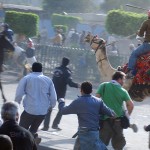
  • “What’s the Fuss: The international community tolerated Mubarak for 30 years.” Mickey Glantz, February 4, 2011

    “What’s the Fuss: The international community tolerated Mubarak for 30 years.” Mickey Glantz, February 4, 2011

    “What’s the Fuss now?: The international community tolerated Mubarak for 30 years.”

    Mickey Glantz, February 4, 2011

    To read the news today either electronically or through printed media you’d think Hosni Mubarak changed from a Dr. Jekyll to a Mr. Hyde. You would think that something bit him while he was sleeping and when he awoke he had been transformed into a horrible dictator. The truth is that he has been a dictator for much of his 30-year rule. The relative voicelessness of Egyptians within the country about his dictatorial rule.

    (despite supposed democratic elections to the presidency) is understandable. Dictators stay in power through a rule of terror by using police and thugs to keep the people intimidated, quiet and powerless.

    What is not so understandable is the 30 years of silence by those governments that worked quietly with and alongside Mubarak’s regime for whatever reasons of state. US does not stand alone in this regard. So, Americans on the Left and on the Right of the political continuum are speaking out against or for American involvement in the Egyptian Revolution. The raving Left (and I am a bleeding heart liberal for the most part) wants Mubarak out today yet they were, for the most part, silent for decades about his rule. The raving political Right blames President Obama for not getting more involved verbally in the Egyptian revolution by calling for support for Mubarak. Both sides point out good arguments to support their views. But that is not my point.

    My point is that the silence of 30 years of dictatorial rule

    in the name of democracy was deafening in retrospect. It was as deafening as is the cries of a million Egyptians demanding that Mubarak abandon his presidency today. The people want him out and out he must go. But what about the scores of dictators running countries not only in the Middle East and North Africa but also around the globe? Will there be demands from the Right and the Left to depose them? Will they demand that their governments take actions to support the aspirations of the people for well-being, freedom and true democracy in their countries?

    Zimbabwe, Congo, Eritrea, Moldova, North Korea and Myanmar stand out as prominent examples of similar governments to target. There are more of them.

    It won’t happen for reasons we can guess. The one ‘excuse’ for their non-involvement (silence, that is) is the old rule of “non-interference in the internal affairs of member states.”

    Q: Mr. Secretary [of Defense, USA] did you speak with the President about the detention of political leaders in this country, the closure of the private press and how it will influence the relationship between your two countries?Answer by Rumsfeld (2002): “You know, yes the subject came up, we discussed it and the ambassador has discussed the issue and issues of that type. All across the globe and a country is a sovereign nation

    and they arrange themselves and deal with their problems in ways that they feel are appropriate to them. By the same token, other countries looking at how those arrangements are make their judgments as to how they feel about it and how they can interact with such countries. And it’s a very straightforward discussion and I think there’s clarity on both sides. And we are personally hoping that the relationship will evolve and strengthen and grow in the weeks and months and years ahead.”

    {Source: Secretary Rumsfeld Press Availability In Eritrea, Tuesday, December 10, 2002,

    http://www.defense.gov/transcripts/transcript.aspx?transcriptid=2855}

    The truth is that UN Charter rule of thumb is used as an excuse to take no action where action is likely warranted. However, that rule has also been put aside, when national interests of other countries were perceived to be adversely affected, politically, financially and sometimes (but not so often) because of humanitarian reasons. Maybe, in the age of globalization, where every country is in every other country’s face, the rule of not speaking out against bad governments has to be scrapped. With globalization of media (TV, Google, Facebook, Twitter and other social networks), there is no longer any place that dictatorial rule (bad governments, corrupt governments) can hide.

    Today in Tunisia and in Egypt it became obvious to all that the proverbial emperors were wearing no democratic clothes. Will the fervor of these popular revolutions prove contagious to other parts of the globe — not just the Middle East and North Africa — to those people who have had no voice and to those on the Right and Left whose voices can influence the policies of their governments on behalf of the oppressed and voiceless people?

  • “The people are revolting. And rightly so.” Mickey Glantz. February 1, 2011.

    “The people are revolting. And rightly so.” Mickey Glantz. February 1, 2011.

    “The people are revolting. And rightly so”

    Mickey Glantz. February 1, 2011.

    A recent ad in a Time Magazine caught my eye. It was a one-page ad to encourage more people to subscribe to TIME. The page contained a photo of a farmer somewhere in the Chinese countryside using a one-tine ox-drawn plow to prepare the soil for planting. Passing high above him and the field he was plowing there was a bridge under construction. The caption on the photo was a play-on-words, a riddle really, “What happens when China catches up with China?”

    The ad’s caption raises lots of questions, for those who took the time to think about the underlying messages sparked, as well, by the images of both farmer & bridge. The ad provides an interesting jumping off point for discussion not only about the benefits of economic development for the well being of people and for the environment, symbolized by the bridge, but also the drawbacks of such development, symbolized by the farmer, the plow, and the ox.

    The TIME magazine one-page ad refers to the current and apparently growing gap in China between the country’s haves, especially the super affluent, and its have-nots, especially those living in abject poverty. With all the news about China’s prosperity, accumulation of dollars, and record-breaking statistics (e.g., the most number of Ferraris in the world have been sold in Shanghai!), the gap between the richest and the poorest segments of society has been growing. The Chinese government noted this concern in 2005: “Even as some Chinese, particularly in the big cities, are able to earn more, many others, notably those in rural areas and the less developed areas of Western China, are being left behind. The result is a widening gap between rich and poor that is attracting growing comment from top officials.” (www.usnews.com/usnews/news/articles/050929/29world.htm)

    China’s population is approaching 1.4 billion inhabitants. Many have done very well with China’s booming economy as a result of economic liberalization and continued future expansion looks like it will be quite robust. There is even talk that the 21st century will be China’s century as an economic power.

    The total population of China, which is like the denominator in a fraction, is much greater than the much smaller percentage of that population can be considered as the “haves” which can be represented as the fraction’s numerator. What would happen if the proportion of the population of “haves” were to sharply increase? The denominator is soooo big that it will not be possible to bring the numerator anywhere near it: hence, a gap. And that gap between richest and poorest has been acknowledged by china as increasing. Even as the numerator gets bigger as more people prosper so too does the denominator increase as the population grows.

    Of course, the have nots of the population hope that their economic situation will improve over time. The other part of the population is weighted toward the poor. The bottom half of the country strives for what the upper half has in terms of quality of life: better food stuffs, more cars on the roads, an increase in air conditioning, and other attributes associated with an improved quality of life. If the “have nots” are successful, China will have to contend with increasingly gridlocked roadways, air pollution, and a continued dependence on the use of fossil fuels, increasing need for food and water supplies, and so forth.

    As suggested at the outset, the question TIME raised also lent itself to the following question: What happens when China fails to catch up with China? In other words, what
    will happen if in the midst of growing affluence by a segment of the Chinese population, the poorer segments of the Chinese population remain poor? Government and Communist Party leaders officially acknowledge that the tens of thousands of protests each year by farmers and workers are on the rise. Chinese leaders are well aware of the potential downsides of rapid economic development and economic liberalization, and they continue to seek to bring about “social harmony.” But rapid economic growth continues and the gaps between rich and poor, city and countryside continue to grow. China, however, is not alone in this regard. In the reverse of the TIME question “What happens when China catches up with China,” the word ‘China’ could be replaced by the many scores of countries for which the question(s) remain relevant.

    Most recently, the multi-decade rule of the Tunisian President Ben Ali came to an abrupt end by the desperate act of a poor, young, 26 year old Tunisian, Mohammed Bouazizi, who was just trying to support his family of eight by selling produce from an unlicensed cart. His cart was confiscated and a policewoman spit on him in a dispute over not having a license for his cart. His self-immolation in front of police headquarters sparked a revolution. That revolution has since sparked similar popular uprisings against other leaders in the Middle East, most vividly in Egypt and in Yemen. So the question remains a useful one to keep in mind for any country, however seemingly stable their government might be, “What happens if Country X does not catch up with Country X?”

    Many dictatorial leaders in the Middle East and elsewhere are probably not sleeping well these days. And rightly so.