Tag: cop 15

  • “International Climate Negotiations (a la COP 15): Playing ‘Twister’ using energy policies instead of colored dots!” Mickey Glantz. 25 December 2009.

    “International Climate Negotiations (a la COP 15): Playing ‘Twister’ using energy policies instead of colored dots!”

    Have you ever heard of a game called “Twister”? Rows of red, yellow, blue and green colored circles on a plastic sheet about two meters by two meters. That is the playing field. A person (called referee) spins an arrow and it stops on a color, which then causes everyone to contort his or her body to be the first to place a hand or a foot on the circle of that color. The end result, after a few spins of the arrow, is a set of people who appear to have interlocked their legs and arms in a pile of contorted humans. The smallest number playing is two. The largest number of players was reported in the Guinness Book of Records as 20,000 on a twister mat that covered an area the size of an American football field (100 yards or more than 90m in length).

    msntwister_vmed_1pwidec

    For those readers who never played Twister, there are rules for the game. How to Play:

    The referee spins the spinner, then calls out the body part and the color that the arrow is pointing to. For example, the referee may call out: “Right hand, red.” All players, at the same time, must then try to follow the referee’s directions as explained below.
    Each player must try to place the called-out body part on a vacant circle of the called-out color. For example, if the referee calls out “Right hand, red,” each player must try to place a right hand on any vacant red circle.
    If your called-out hand or foot is already on a circle of the called-out color, you must try to move it to another circle of the same color.

    twister

    There can never be more than one hand or foot on any one circle. If two or more players reach for the same circle, the referee must decide which player got there first. The other player(s) must find another vacant circle of the same color.
    Never remove your hand or foot from a circle, unless you’re directed to by the referee after a spin. Exception: You may lift a hand or foot to allow another hand or foot to pass by, as long as you announce it to the referee beforehand, and replace it on its circle immediately afterward.
    If all 6 circles of a color are already covered, the referee must spin again until a different color can be called out.

    As I read about the various climate and energy conferences, workshops, and public statements of top political leaders at summits like the G-20, the G-77 + China, or even within the US government and as I watch the US two Houses of Congress twist and turn to protect the special interests that they represent — coal industry, oil & gas sector, outspoken scientists (true believers as well as skeptics) — I am now convinced that they are unwittingly engaged in a Realpolitik version of the game of “Twister”. Instead of colored circles though, there are various policy options for coping with the causes and consequences of a human-induced climate change resulting from increased amounts of greenhouse gas emissions due to human activities. Positions are bent, twisted, turned, mitigated (e.g., softened), even changed permanently or in flip-flop ways. Negotiations proceed with each player (a country or a group of countries) seeking the best advantage point for itself or his/her country, while at the same time trying to gain advantage over the other players.

    In the game of Twister, there can only be a winner or two, with so many players participating in the game. Where there are winners, losers (absolute and relative) cannot be far behind. So, playing the game requires some level of skill mixed with a modicum of cunning. Those without these attributes are likely to find themselves on the sidelines as observers, having been forced out of the game.

    An example in my mind of a poor strategy for the climate change political twister game is a fairly recent statement by a representative or two of African countries that if Africa does not get $200 billion a year from the industrialized countries, Africa would boycott the December negotiations in Copenhagen, eg, COP 15. Bad idea. Africa is not, has not been and will not be a major emitter of greenhouse gases. As the victim of the potentially devastating consequences of a human-induced global warming, it will find itself in line with other victims seeking assistance and many would need assistance to cope with climate change well before other (including African) countries, eg, the AOSIS countries, Bangladesh and major low-lying coastal mega-cities worldwide, at risk of inundation resulting from sea level rise. Africa does not have a climate change card to play except in the humanitarian arena and in the UN General Assembly where countries vote on issues. A better strategy is for African countries to find the appropriate level of negotiating points twists and turns to get what it wants without the risk of being sidelined and voiceless.

    In a game of twister bluffing is a weak option. It may work once or twice, faking out opponents but eventually they become increasingly aware of someone’s propensity to bluff. As in politics, one hopes that eventually words will have to match deeds. Over time if one’s words have not done so, then his/her credibility is lost. Once lost, it is hard to get back. In this regard governments often pledge to do a wide range of good things but in reality it turns out that they often fall well short of their stated (maybe even desired) goals, especially in the absence of mechanisms to verify if pledges have been met.

    Meanwhile the planet is heating up. No longer do people talk about a 2 deg C limit for acceptable climate change; now they talk of 3 deg C. Today we talk about billions of dollars in the same way we used to talk about millions of dollars, as the worldwide financial crisis ballooned out of control. And now we are starting to talk about trillions of dollars like we used to talk about billions just a year or two ago.

    It seems that the resolve of governments and of the US Congress is slipping away from finding solutions in the near term to address the increase of greenhouse gas emissions in order to avoid a dangerous changes in the global to local climate systems. It looks as if the climate change twister game runs the risk of having no winners.

    Nero is said to have fiddled as Rome burned. It seems we have heard about this lesson of history but unfortunately, not to use it as a lesson learned in order to avoid it, but to conscientiously repeat it. So it goes, when human and political nature is in conflict with the natural environment.
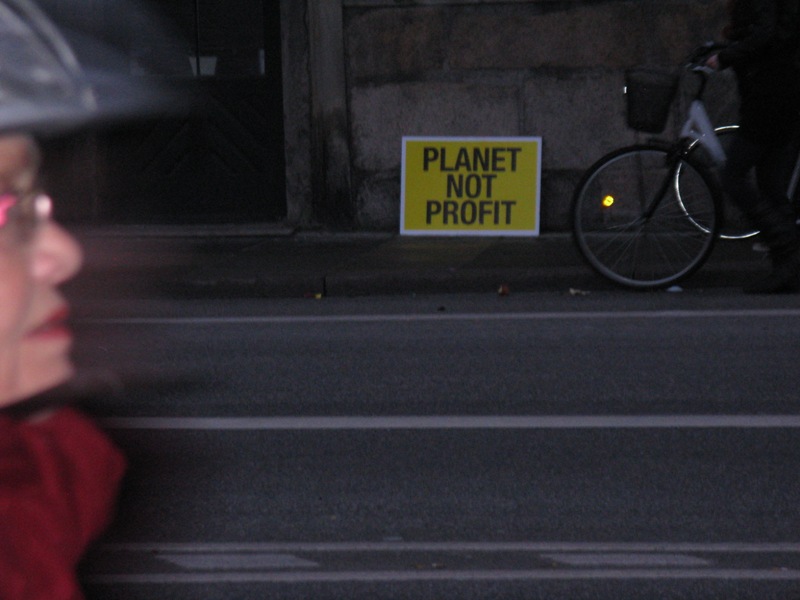
  • “Slogans to rule by: climate change messages from civil society.” Mickey Glantz. December 23, 2009

    Slogans to rule by: Street wisdom messages from civil society

    COP 15 taught me something. The best messages are the shortest messages. I attended a side event at COP 15, for example. Each speaker gave his 12-minute presentation on one of a range of climate change related issues centered on equity. More specifically, the talks were different perspectives about who should pay what to whom as a result of the saturation of the atmosphere with carbon dioxide and other greenhouse gases.

    In retrospect, the speakers gave isolated presentations, each with his (all were men) or his organization’s solutions to cope with the equity aspects of climate change. First of all, most if not all seemed to have equated equity with equality: yet they are overlapping but different concepts. Equity is about fairness; equality is about being equal. Secondly, not one of the speakers addressed points raised by previous speakers. Each came to make his statement that was usually embedded with other information. As a result, it was up to the listener to draw the appropriate conclusion as to his main message. Participants emptied the room after the session, satisfied for having attended and heard a range of papers. But, what were the take-home messages from each of the speakers? Personally, I cannot recall them.

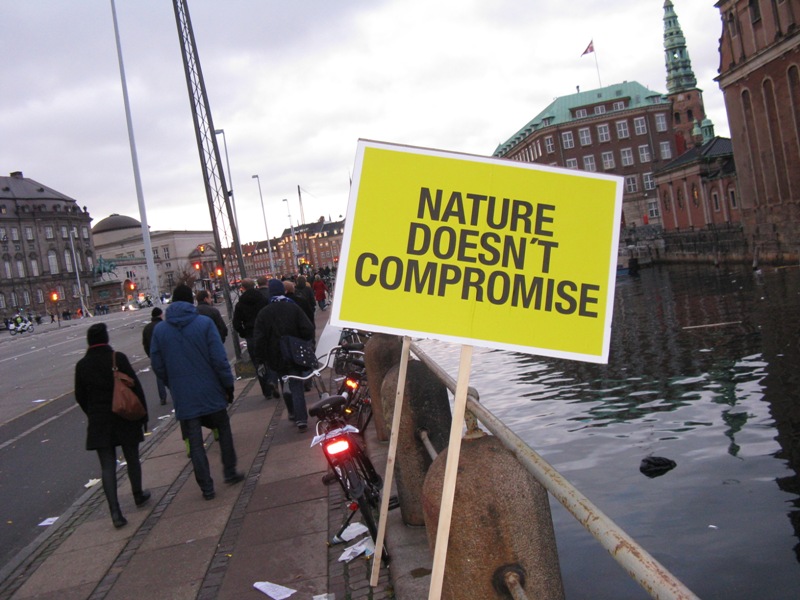
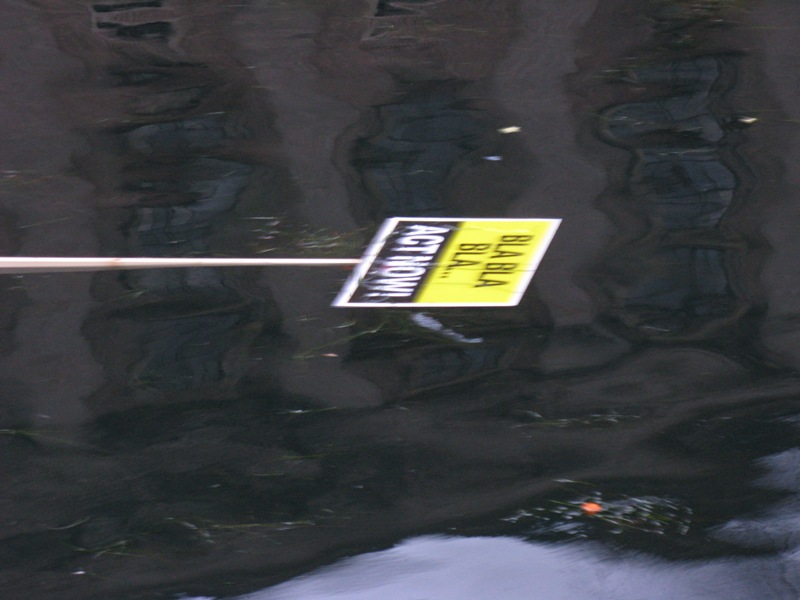
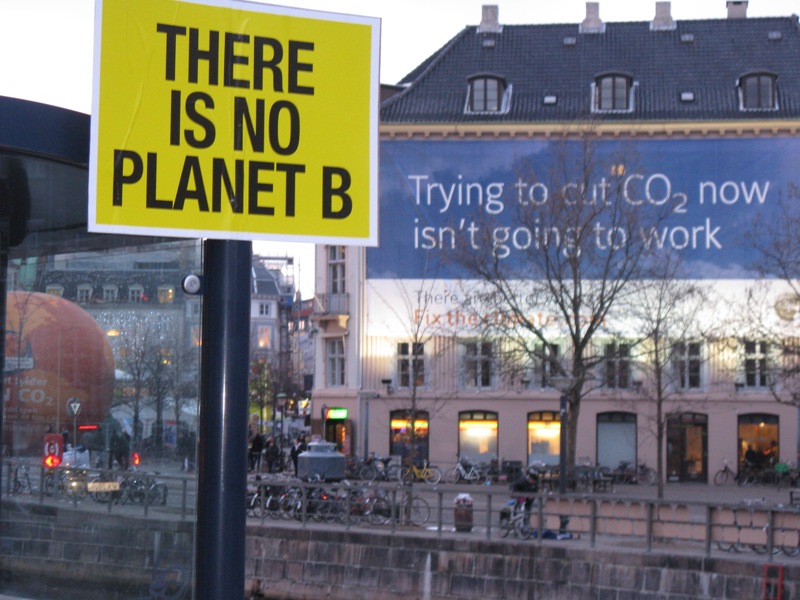
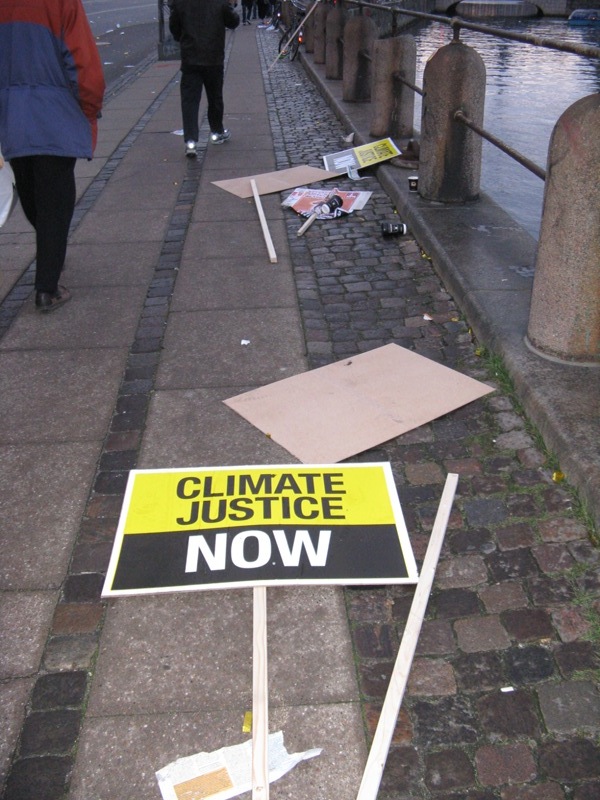
    Shift attention now to the streets of Copenhagen. At the end of the first week, there were street protests in the form of rallies and long marches from the center of town to the Bella Conference Center where the COP 15 negotiations were being held. Protesters carried placards with short-to-the-point messages for others to see, including the media. The statements on the placards provided clear and simple statements that were meant to serve as food for thought: “There is no Planet B”; “Change the system, not the climate”; “Bla, Bla, Bla”; “Nature does not compromise”, “Planet not Profit,” and so forth.

    These statements, slogans from the streets if you wish, were to the point. They were messages to leaders, negotiators, the media and the rest of civil society including global warming skeptics about what to keep in mind as they try to discuss whether or how to cope with the causes and foreseeable consequences of a changing climate. There is a lot of wisdom in these basic statements, if only people take the time to ponder their deeper meanings, hopefully influencing behavior.

    As is usually the case, the media, the politicians, negotiators and the public focus do not focus on the street wisdom adorning the placards but on the methods of delivery of those messages: the march, the gathering, the riot, the protest, etc. Yet, in my mind the true value of the demonstrations rests with the ideas succinctly stated on the placards.

    So what are the chances that policy makers or negotiators — or anyone but a protester — might pay attention to, and think more deeply about, the meanings behind the slogans on the placards by people in the streets? Society will benefit as will the policy making process if policy makers and negotiators — in this case for controlling greenhouse gas emissions — pay serious attention to those slogans. Being ignorant of an issue in one thing that can be corrected with open eyes and ears. “Ignore-ance,” that is, the deliberate rejection of useful information is more difficult to fix, because those who practice it do not want to be educated with facts.

  • ”Dreaming the Impossible Dream: Swords into Plowshares (and other economic development tools).” DAY 6 thoughts at COP 15. Mickey Glantz December 17, 2009

    {NOTE to the Reader to avoid misinterpretation: The Following editorial is about money and military expenditures for maintaining armies and for fighting wars or staying in power. The US started the wars in Iraq and Afghanistan and have put at least $1 trillion into the effort. Could those funds have been used for development purposes both in the USA and in the developing world? If there were no wars and the militaries around the globe could reduce their budgets because of a reduction in conflict (at present terrorism is seen as the major threat to government; also dictators maintain their military establishments to stay in power [the list of these is long and we all know who they are!]), governments worldwide could turn attention and funds to economic development activities with substantial funds available to do so. That is the spirit in which the following is written}.

    On the way to COP 15 at the Bella Convention Center in Copenhagen one morning, I got to thinking about both the COP 15 official UN-sponsored conference and the KlimaForum09, the public’s climate change conference. That led me to wonder about a missing element in the conferences: There was no hint anywhere of the United Nations’ basic unofficial slogan and underlying theme “Beating swords into plowshares.” Yet everyone these days is referring to climate change as a security issue.

    Just about every country in the world provides a relatively large portion of its national budgets to its military establishment. Worldwide military expenditures have been estimated at $1.1 trillion around 2005. An estimated $500 billion was from the rest of the world while the US expenditure was about $600 billion. That is just the cost to maintain the military establishments. It does not include the cost of a hot war (for example, the cost of the Iraq and Afghanistan wars to the United States has been estimated to date at more than $1 trillion).

    We have learned from previous war efforts that there seldom is a “peace dividend”, that is, when a war ends, the funds used for the war are never available for peace-building activities.

    Developing countries demand that industrialized countries (e.g., the rich countries) pay hundreds of billions of dollars annually into the future to cope with a changing climate due to the emissions of heat-trapping greenhouse gases since the mid-1700s. The demands are based on the claim that the developing countries are the victims. The demands are made in the midst of a major financial worldwide meltdown.

    The US has already spent (officially) $1 trillion on its Central Asian wars; the costs will surely rise. What if those wars were to be brought to an abrupt end and the equivalent amount of the war funds could be diverted to help developing countries successfully prepare for and cope with climate change?

    However, the fact is the US and other countries are currently besieged by terrorism. For national security they –build (or create) super-sized military establishments compared to the size of their national budgets. In the absence of threats, military establishments could in theory at least be reduced and development activities increased. So, how about considering the following scenario to fund developing country programs and projects in the face of a changing climate: Governments that support terrorist groups (morally, politically or financially) must stop terrorists from operating within their borders. If this were done funds could be transferred from the anti-terrorist hot conflicts to activities that develop their countries economically. This would constitute a “peace dividend”.

    Because governments continue to support terrorist groups, funding from rich countries will continue to flow to fight terrorists and not to development. It is ludicrous that several governments that are members of the “Group of 77 + China” (this is the largest group of developing states in the United Nations. There are now 130 members) demand large sums of financial support to cope with climate change causes and consequences, while at the same time some of these countries are supporting terrorist groups whose hostile activities requires large sums of money to combat. For example, the Sudanese representative speaking for the “Group of 77 and China” to the COP 15 climate negotiations demands $200 billion for developing countries while his government supports terrorism. Sudanese representative to the Group of 77 Lumumba Dia-ping stated the demand in the following way: “You approve billions of dollars in defense budgets. Can’t you approve 200 billion dollars to save the world?”

    Zimbabwe’s President Robert Mugabe addressed COP 15, challenging the industrialized “North” to provide more climate change related funds to developing countries. Is he the best spokesperson for more funds, because his human rights record in his country in abyssmal.

    Governments must begin to consider scenarios centered on “beating swords in to plowshares” as a way to provide the community of nations with a tangible peace dividend. Not only should they pursue equity among states in the international community but should pursue equity within their own borders as well. Not to work toward a ‘peace dividend’ scenario means business as usual, that is, hot wars, large military establishments worldwide, not to mention a thriving international arms trade. Does the slogan “Give Peace a Chance” ring a bell?
    John Lennon singing \”Give Peace a Chance\”

  • Mickey Glantz, “Bloggin’ from Copenhagen: Day 1 at COP15”

    I am attending COP 15 and it is a foggy and cold day, not too windy but the wind chill is still significant. The chill though is way overshadowed by the enthusiasm and commitment of the people trying to get in to the Conference Center where the action is, at least for the non-governmental organizations NGOs). They had come from around the globe to attend this potentially historic event. Many of course were not used to the weather but stood in line for long periods of time anyway. they wanted to be a part of the process. Was COP 15 unprepared to help them? As far as registration procedureswere going, I’d have to say …yes.

    The commitment of the members of NGOs was quite clear outside the conference hall, as they had to stand outside in long lines waiting to register. There were groups along side the line acting out so to speak, trying to draw attention to their specific message; they chanted “stop the warming”, showed a video on climate change is ultimately about people, free coffee in support wind power,and greenpeace supporters mingling with the crowd.

    cop15: a 4 to 5 NGO hour line

    OOOPs. Apparently someone thought it was appropriate to postpone COP15 registrationfor NGOs until noon on the first morning of the first day. Not sure why, but the general feeling was that the organizers did not want any distractions from the opening ceremony for COP 15. I wonder if the hardy, used-to-the-cold-Danish-weather Danish COP 15 organizers gave any thought at all to the thousands of people from around the world who would have to stand outside and in a slow-moving line to register.

    The group I was to register with gave up trying to register today, when a policewoman informed us that the line would likely take us about 4-5 hours and we would likely not get into the Center because registration would close at 6pm. We decided to try again tomorrow.

    We went into the city center and we could see many huge posters supplied by the Danish or other governments, corporations, NGOs andcivil society that covered the sides of large buildings.

    posters to stop climate change in Copenhagen

    This gave us the feeling that many citizens, especially young people, were sincerely engaged in pursuing a voice in climate change policy making. Their collective actions throughout the city drowned out the words a Danish climate change skeptic, Bjorn Lomborg — at least for the next couple of weeks.