Tag: Climate Change

  • “Global Warming ate my homework: In Defense of Legitimate Skepticism About Climate Change.” Mickey Glantz. June 30, 2010

    Poor “global warming.” It seems it is getting blamed for everything under the sun! It is blamed for droughts, floods, forest and bush fires, heat waves, disease outbreaks and the spreading of desert-like conditions. It is blamed for the illegal migration of people from one country to another, and so forth.

    When I was in middle school, teachers would give out homework assignments with instructions to turn in the homework the next day. One time I didn’t do it. When asked by the teacher why I didn’t give her my homework, I lied. I said, as did many other kids my age across America that “my dog Fido ate my homework.”dog_ate_my_homework

    Like Fido, the unruly dog, global warming gets blamed these days for everything unpleasant that happens. That is a disservice to Fido and it is clearly a disservice to the global warming issue. Some people argued that Hurricane Katrina, for example, was strengthen by global warming when in fact it was just a strong hurricane not an extraordinary one.

    Opinions about the possible impacts of global warming are rampant in the printed and electronic media and, in many instances, are not based on facts but on subjective opinions. Was this or that specific drought or flood or fire the result of natural variability in the climate system or was it the result of human induced warming of the global atmosphere? When will we be able to identify the actual impacts attributable to global warming: some say we can already see them while others say we’ll never be able to sort it out between what is the result of natural variability versus an actual warming of the global atmosphere.

    The media does not help. They tend to seek balance of opinions, even when balance is not really warranted. So, those who believe in global warming’s influence on intensifying hurricanes and in increasing their frequency will tend to state that perspective to the press. Even if a large majority believes it is so, the media still call for an opposing statement that rejects that perspective, seeking to ‘level the playing field’ when it does not need to be leveled. Fact and fiction are presented as are subjectively based wishful thinking and guesstimates.

    So, it is no wonder that the public remains confused about the science of global warming, about its real possible consequences. Global warming has become a business of sorts, an industry much like the drought industry (industria da seca) that exists to assess drought-plagued Northeast Brazil. The drought industry is made up of people who come from all social and economic sectors of society as well as from just about every academic discipline at a university. There is money to be made off of hazards. There’s money to be made: by researchers, by engineers, by technologists, by the news media, and especially by those who are savvy enough to capture the media’s attention to expose their views, opinions, whatever on climate change.

    We have to become more responsible about how we talk about the global warming issue. We have to reduce the hype, encourage solutions and educate individuals and policymakers about the issue and its relative priority to other pressing issues. We should openly and aggressively challenge knowingly false claims using sound reasoning.

    We quote polls and surveys which to me are interesting but relatively useless for action. I say this because accepting a poll’s findings requires trust and I for one have lost that trust for polls and interviews regarding beliefs about global warming. Though I might know better whom to believe or whose views to challenge, many people around the globe do not know how to calibrate the views of commentators about global warmingpollnumbers1250985368

    In the USA for example, a sizable portion of a survey’s respondents blamed the destruction of New Orleans during Hurricane Katrina on God’s wrath because of the corrupt lifestyle of the city’s inhabitants! As another example, the UN Secretary General stated his belief that the violence in Darfur, western Sudan was the first global warming war! Comments like these must be challenged.

    Scientists, media, policy makers must be more responsible about attributing various climate-related impacts to global warming (or to denying such attributions). In truth anything that society does is happening under a changing climate; the climate is always changing. The contemporary concern is about the level to which it changes and the rate of that change.

    The UN has two definitions of how to look at adaptation as a response to climate change: (1) adaptation of society only to changes attributable directly to global warming and (2) any changes related to climate. The latter makes it easier to respond to climate impacts on the part of society. The former sets up an untenable situation in which human influence on climate must be unquestionably identified before action is to be taken, whereas the latter makes it easier for the researcher.

    My teacher knew right away that the homework had not been done and probably knew that I did not even have a dog. She was skeptical from the outset. I think that the attributions that are made by scientists, among others, require closer scrutiny than we have tended to do to date. Global warming like Fido should not be taking the blame for all our inconveniences. As research has shown time and again, the behavior of societies has a lot to do with the impacts of even normal weather. It may take decades before some of the occurrences in Nature can accurately be blamed on global warming.

  • “’Robocopping’ the Planet: Geo-engineering the Planet’s Climate system,” Mickey Glantz 1 June 2010

    Mickey Glantz,

    1 June 2010

    Almost twenty-five years ago, the Hollywood movie Robocop appeared on the silver screen. The plot summary was quite simple, according to IMDB: “In a dystopic** and crime ridden Detroit, a terminally wounded cop returns to the police force as a powerful cyborg,” part human and part machine. robocop-bigposter-orig

    It seems that the scientific community and governments around the world are following the Robocop plot, applying it, by analogy, to plant and animal species around the entire planet. For example, we continue to drive animals in the wild towards extinction but try to save a few for our zoos. Other species, known to be endangered, have continually increased in value to those who seek their products – the rhino for its horn (an alleged aphrodisiac in Asia) and the lowland gorilla for its paws (used as ash trays!) are two prominent examples. Less well known are the wetlands that are everywhere being drained and the rainforests that are worldwide being cut down for political and economic reasons. Indeed, we persistently destroy good, productive farmland and then attempt to grow the same amounts of food in less suitable soils and climates.

    These are but a few apt examples around the planet of the Robocop analogy: we destroy different parts of the earth’s surface then we resort more and more to technologies to create artificial environments to replace those environments we have destroyed. This growing trend has led to a nasty cycle wherein artificially created ‘technovironments’ are becoming more valuable to people, both economically and perceptually, than those natural environments that are being replaced. In recent years, this situation has emerged in consideration of the global climate system.

    A couple of thousand scientists from around the globe have published their consensus view that many human activities are now producing greenhouse gases that are intensifying the naturally occurring greenhouse effect. As a result, the atmosphere of planet earth is heating up. The concern is that this heating will increase temperatures by at least 2 to 3 degrees Celsius or more by the end of the century if not sooner. The question, of course, is whether or not societies and the ecosystems on which they depend can adapt to the changes that accompany climate change, especially at the rapid rates at which those changes could realistically occur. The consensus of those couple of thousand scientists who participated in the 4th assessment report of the Nobel Prize winning IPCC (Intergovernmental Panel on Climate Change) appears to be that societies will be unable to keep up with those changes; even so, there is as yet apparently not enough political will to stop the industrial and land-use practices that continue to produce such greenhouse gas emissions.

    Enter Robocop . . . by analogy. The response of some key members of the scientific communities in both the USA and Europe has been to propose various ways (theoretical conjectures, really) to control the planet’s climate, either by ratcheting down the temperature or at least controlling it so that it does not turn into a runaway greenhouse effect. They have proposed mimicking volcanic eruptions by spewing aerosols into the stratosphere, evaporating sea water to brighten lower level clouds that prevent the sun’s rays from reaching the earth’s surface, putting millions of mirrors in space, creating artificial trees to suck carbon dioxide out of the air, and so on.

    The reality is that a field of artificial carbon-sucking tree-like technological devices is not a forest. Nor will it ever be. Pumping ever-increasing amounts of societally emitted greenhouse gases into the air is converting our atmosphere into an artificial (non-natural) environment. The question is when is a cyborg no longer a cyborg? At what point does replacing yet another living part of the planet with yet another technological device, further converting the cyborg – which is, at this point, partially natural life and partially designed machine – turn the entire planet into little more than a crudely assembled technological device? When does the earth as ‘technovironment’ become a much less-than-perfect “Robocopy” of the original living system so well described by James Lovelock’s Gaia hypothesis?James Lovelock

    Geoengineering schemes are being proposed because governments seem to have put on the back-burner efforts to reduce their dependence on fossil fuels. They are likely to muddle along until a full-blown climate crisis occurs. They will continue to build coal-fired power plants, while trying to figure out how to suck that excess carbon dioxide out of the air. They will continue to cut down forests and try to manufacture artificial trees. They will do anything they can to continue “business as usual” and therefore they will not reduce the carbon emissions on which they now depend for economic development. In other words, their true interest lies in “Robocopping the planet’s climate.” If adaptations through such science fictions are allowed to continue, humanity is lost.

    The reality is that modern humans have not been around very long. Policymakers should be reminded each day of this truism: while we need much of the natural environment kept intact, it does not need us at all.
    ————————————————-

    ** Dystopia: An imagined universe (usually the future of our own world) in which a worst-case scenario is explored; the opposite of utopia. Dystopic stories have been especially influential on postmodernism, as writers and filmmakers imagine the effects of various aspects of our current postmodern condition, for example, the world’s take-over by machines (The Matrix); the social effects of the hyper-real (Neuromancer); a society completely run by media commercialism (The Running Man); the triumph of late capitalism (Blade Runner); bureaucratic control run amok (Brazil, 1984); and so on.

  • GUEST Editorial: “Brazil-Africa ‘Biofuels Diplomacy’: South-South Relations on the Rise.”

    Marcelo Paiva & Tsegay Wolde-Georgis, University of Colorado’s Consortium for Capacity Building. 8 March 2010


    Brazil is considered a global leader in sugarcane-based ethanol biofuel production & technology. It made strategic decisions to develop alternative forms of energy for transportation following the crisis and oil embargo in the early 1970s. In 1979, Brazil had developed the first commercial vehicle powered 100 % by ethanol.

    The record oil prices of 2007-08 shocked many leaders around the world. Both fuel and then food prices went through the roof both in developed and developing countries. Many developed countries began to introduce, or accelerate approval of, polices that encouraged the development of biofuels, while Brazil found itself in a very advantageous position to export its technology to other developing countries.
    braz-afrmap
    While over the years the price of food has gone up, so has the price of fossil-fuels on which the farmers’ machinery relies to work the land. In addition, there is concern about greenhouse gas emissions from fossil-fuel burning which contributes to the heating of global temperatures and to a constantly changing climate. What’s more, the peak oil clock ticks uninterruptedly so countries cannot expect to rely on non-renewable cheap forms of energy much longer.partys-over

    The idea that biofuels can rescue us from an irreversible energy crisis is contentious, and the reactions in different parts of the world have been dubious. Some argue that biofuel investment can take away the focus on land for food production, driving food prices up, whereas others argue that marginal lands (read: “unused land”) could be used at a positive net benefit for the environment while boosting infrastructural development in that area. Regions of the world that are perceived as “land rich”, like parts of Africa, became a focus of attention for biofuels investment.

    Several countries have been looking to Africa as a new frontier for cost-effective biofuel production, and the issue of peak oil makes energy security a matter of national security for countries like the US, but also for other nations around the world who see fossil-fuel dependence as an obstacle to development. Oil prices, however important, are not the only incentive for biofuel investment; “going green” can also be beneficial for rural community development and revitalization of the rural economy (there are less farmers and more “urban-ers” in the world every year), but also a long-term benefit found in the reliability on renewable-energy. Africa has land and Brazil has the technology and expertise, and the current political administration in Brazil has been championing biofuels diplomacy as an important piece of its foreign policy.

    One thing is certain: however stealth to the common energy consumer, the renewable-energy market shift is imminent, and is proving lucrative. As oil giants like Exxon-Mobil and Royal Dutch Shell move to partner with biofuels investors, it highlights new trends in energy development investment in the tropics. Also noteworthy is that Brazil’s biofuel diplomacy is taking place in a very competitive environment: other emerging economies like India and China are pursuing land acquisitions through the purchase and lease of land in Africa to grow biofuels feedstock and for food production geared toward their own domestic consumption. Competitiveness can provide for a very fast-growing market.
    gascanroots
    In Africa, biofuels could be viewed as the beginning of a brighter future, as a result of investing in renewable energy in countries that have been primarily exporting agricultural products with declining terms of trade. Many African leaders believe that the biofuels revolution will be a new opportunity leading to energy security and revitalization of the agricultural sector in Africa. Most energy sources of rural Africa are currently based on the direct use of biomass such as dung and wood, which are already being used as low-tech biofuel. Liquid biofuels can be a healthy transition into the future if used properly to substitute traditional biomass.

    The investment in biofuels also raises questions about the carbon footprint benefit of producing and using biofuels like ethanol from corn or sugarcane, since the overall gain (with current technology and market prices) may be marginal. The diminished carbon footprint, however, is but one argument in favor of biofuel production. As mentioned by Rory Williams in A Definition of Sustainable Mobility, the investment in biofuels provides, in addition to potential for a cleaner environment, the support for other sustainable objectives like improved energy security, through the reduced reliance on fossil fuels, and local job creation.

    The South-South partnership such as the one Brazil is pursuing in Africa is a way of maximizing African interests which have historically been exploited by the European neo-colonizers. Like China, Brazil is being utilized by African governments to counter the European infrastructural economic domination.
    lulaangola
    This increased interest in Africa reveals that it is possible to bring development to Africa and, while biofuels are seen as a profitable activity for investors, it also brings independence from fossil-fuels, economic stability and environmental benefits.

    Countries like Angola, Mozambique and Nigeria may well see the biofuels feedstock crops filling their landscapes, but they will hopefully see infrastructural development, employment and technology transfer as well for those working with the biofuels crops in the form of more schools, hospitals, better water treatment facilities and an improved quality of life. For this to ensue in a sustainable way, it is important to pay close attention to the laws and regulations of the African countries.

    The current “land grab” competition in Africa is representative of a new trend, but African policy makers must be prepared to cope with unintended consequences of the rush to embrace a new technology. To minimize those adverse side effects, biofuels strategies should incorporate adequate environmental and societal impact assessments. It should also include protection of farmers from being removed from their land (by design or accident) and the protection of ecosystems from a loss of biodiversity in the face of putting land into biofuels production. After all, development also needs to be cultivated with great care in order for it to yield its most positive results.sustainability-chart

  • Is Osama Bin Laden going ‘green’? Mickey Glantz, 1 February 2010

    Associated Press writers (Keath and Nasrawi) reported that Osama bin Laden, the al-Qaida leader, blamed the United States and other industrialized nations for climate change and said the only way to prevent disaster was to break the American economy, calling on the world to boycott U.S. goods and stop using the dollar.

    The AP writers suggested that bin-Laden’s message on climate change was designed to show the world that he and the movement he started were focused only on one issue: destroying America.

    “The effects of global warming have touched every continent. Drought and deserts are spreading, while the other floods and hurricanes unseen before the previous decades have now become frequent,” bin Laden said in his most recent audio recording, aired on the Arab TV network Al-Jazeera.

    The terror leader noted Washington’s rejection of the Kyoto Protocol aimed at reducing greenhouse gases and painted the United States as in the thrall of major corporations that he said “are the true criminals against the global climate” and are to blame for the global economic crisis, driving “tens of millions into poverty and unemployment.” Well, we know that bin Laden does not like the United States and would like to see it pay for all the damages worldwide resulting from its greenhouse gas emissions.

    The above commentary is real. Bin Laden did release an audio tape. He did talk about climate change and about America needing to be challenged for saturating the global atmosphere. But my first reaction was “Who cares what bin Laden thinks about the Earth’s environmental problems?”

    I certainly don’t. I can’t image that many people do. I wonder why the media bothered to even report it. Would the media care what Charles Manson has to say about climate change?

    Why did he do it? It was the first message from bin Laden devoid of mention of support for al Qaida and attacks on the US and its allies. But let’s play along and fantasize about al-Qaida’s attempt to broaden its support by appealing to environmental groups (as if that would work, or environmentalists would want their support).

    Here’s the whimsical (not real) scenario.

    Bin Laden has decided that arresting global warming has become more urgent that dislodging what he sees as America, the evil empire. He calls off the jihad again the USA and Europe. He issues a secret order to al Qaida operatives demanding that they prepare climate change risk disclosures (CCRDs) for their operations. He orders them to reduce their greenhouse gas emissions by 20% by 2015. Al Qaida then is asked to participate in carbon cap and trade and to shift its energy dependence from fossil fuels (including Saudi Arabian oil) to renewable energy sources including solar and wind. He then demands that American engineering concerns provide new clean technologies to al Qaida cells and that the U.S. Treasury pay compensation for global warming related damages that have already occurred.

    Let’s take this tongue-in-cheek scenario a step further: might we soon be hearing headlines like, “bin Laden calls on al Qaida to field a football (soccer) team for FIFA,” or “al Qaida to participate in gymnastics competition at the 2012 Olympics,” or, perhaps, “bin Laden picks Saints to win Super Bowl”?

    More seriously, one has to wonder what prompted Osama bin Laden to speak out on global warming. Does he want to be remembered as a 21st century Gandhi? Is his health failing? Is he seeking to broaden his support among environmentalists? Is he striving for a Nobel Peace Prize? Or, is he feeling neglected?

    Only time will tell what motivated him to talk now about global warming. I think that whatever it was it was more personal and psychological than political.

  • “Slogans to rule by: climate change messages from civil society.” Mickey Glantz. December 23, 2009

    Slogans to rule by: Street wisdom messages from civil society

    COP 15 taught me something. The best messages are the shortest messages. I attended a side event at COP 15, for example. Each speaker gave his 12-minute presentation on one of a range of climate change related issues centered on equity. More specifically, the talks were different perspectives about who should pay what to whom as a result of the saturation of the atmosphere with carbon dioxide and other greenhouse gases.

    In retrospect, the speakers gave isolated presentations, each with his (all were men) or his organization’s solutions to cope with the equity aspects of climate change. First of all, most if not all seemed to have equated equity with equality: yet they are overlapping but different concepts. Equity is about fairness; equality is about being equal. Secondly, not one of the speakers addressed points raised by previous speakers. Each came to make his statement that was usually embedded with other information. As a result, it was up to the listener to draw the appropriate conclusion as to his main message. Participants emptied the room after the session, satisfied for having attended and heard a range of papers. But, what were the take-home messages from each of the speakers? Personally, I cannot recall them.

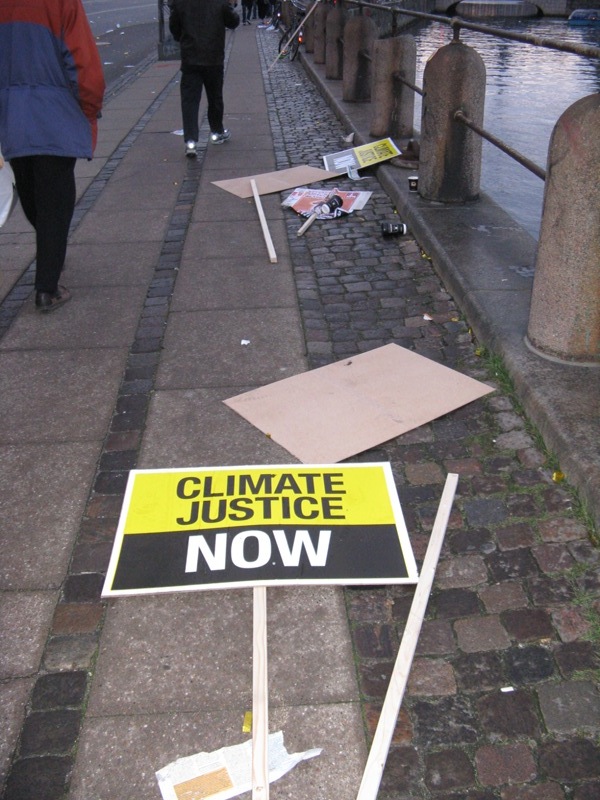
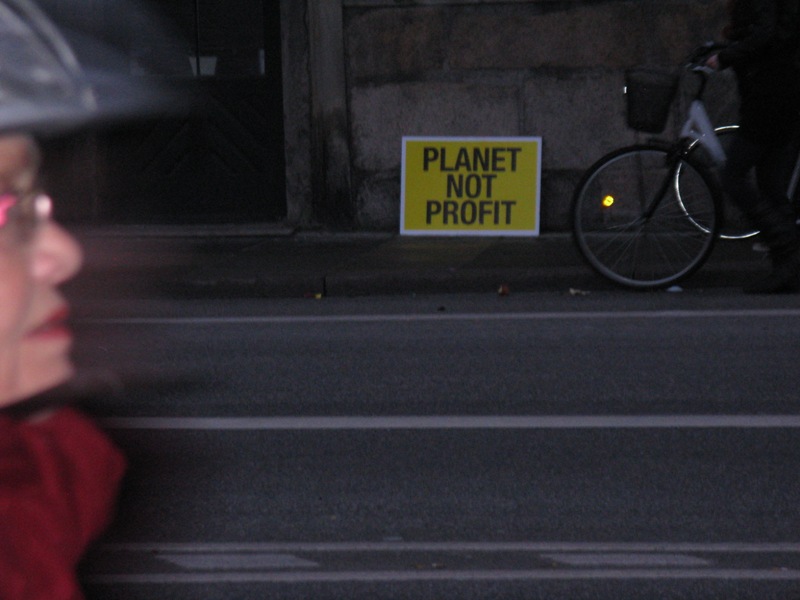
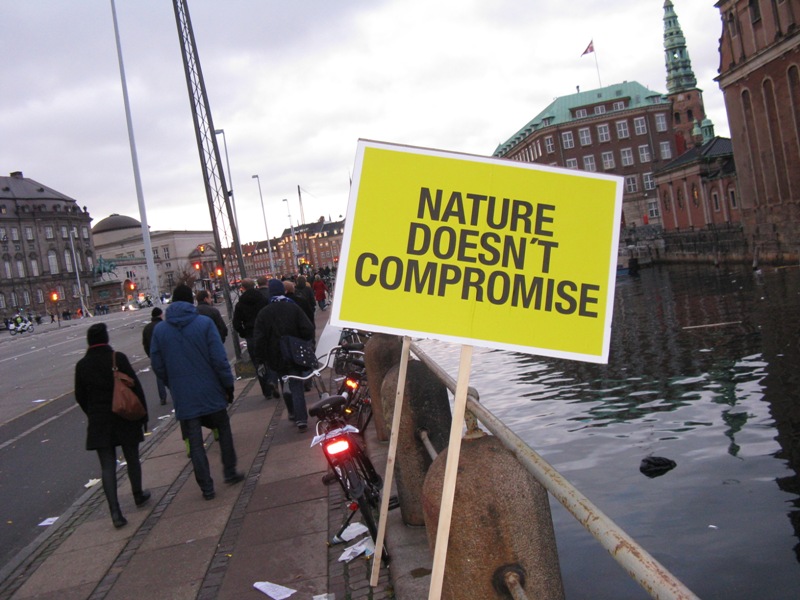
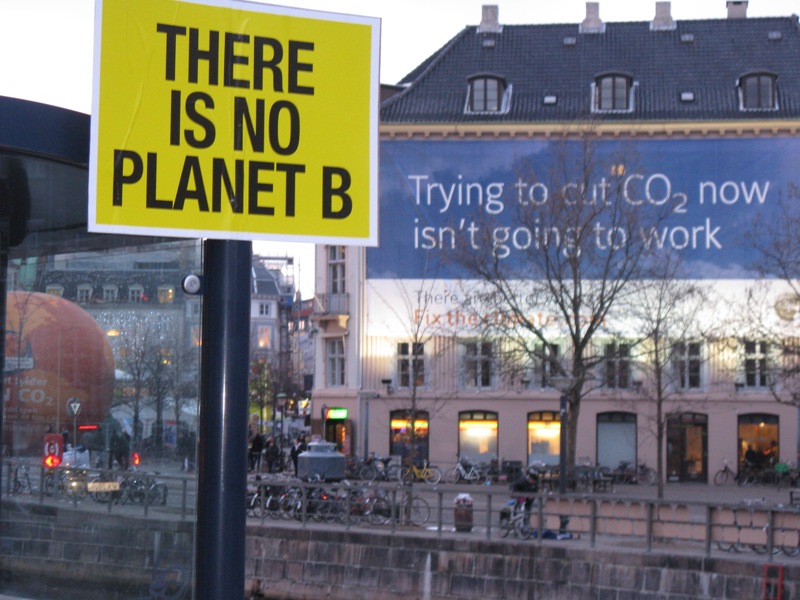
    Shift attention now to the streets of Copenhagen. At the end of the first week, there were street protests in the form of rallies and long marches from the center of town to the Bella Conference Center where the COP 15 negotiations were being held. Protesters carried placards with short-to-the-point messages for others to see, including the media. The statements on the placards provided clear and simple statements that were meant to serve as food for thought: “There is no Planet B”; “Change the system, not the climate”; “Bla, Bla, Bla”; “Nature does not compromise”, “Planet not Profit,” and so forth.

    These statements, slogans from the streets if you wish, were to the point. They were messages to leaders, negotiators, the media and the rest of civil society including global warming skeptics about what to keep in mind as they try to discuss whether or how to cope with the causes and foreseeable consequences of a changing climate. There is a lot of wisdom in these basic statements, if only people take the time to ponder their deeper meanings, hopefully influencing behavior.

    As is usually the case, the media, the politicians, negotiators and the public focus do not focus on the street wisdom adorning the placards but on the methods of delivery of those messages: the march, the gathering, the riot, the protest, etc. Yet, in my mind the true value of the demonstrations rests with the ideas succinctly stated on the placards.

    So what are the chances that policy makers or negotiators — or anyone but a protester — might pay attention to, and think more deeply about, the meanings behind the slogans on the placards by people in the streets? Society will benefit as will the policy making process if policy makers and negotiators — in this case for controlling greenhouse gas emissions — pay serious attention to those slogans. Being ignorant of an issue in one thing that can be corrected with open eyes and ears. “Ignore-ance,” that is, the deliberate rejection of useful information is more difficult to fix, because those who practice it do not want to be educated with facts.

  • ”Dreaming the Impossible Dream: Swords into Plowshares (and other economic development tools).” DAY 6 thoughts at COP 15. Mickey Glantz December 17, 2009

    {NOTE to the Reader to avoid misinterpretation: The Following editorial is about money and military expenditures for maintaining armies and for fighting wars or staying in power. The US started the wars in Iraq and Afghanistan and have put at least $1 trillion into the effort. Could those funds have been used for development purposes both in the USA and in the developing world? If there were no wars and the militaries around the globe could reduce their budgets because of a reduction in conflict (at present terrorism is seen as the major threat to government; also dictators maintain their military establishments to stay in power [the list of these is long and we all know who they are!]), governments worldwide could turn attention and funds to economic development activities with substantial funds available to do so. That is the spirit in which the following is written}.

    On the way to COP 15 at the Bella Convention Center in Copenhagen one morning, I got to thinking about both the COP 15 official UN-sponsored conference and the KlimaForum09, the public’s climate change conference. That led me to wonder about a missing element in the conferences: There was no hint anywhere of the United Nations’ basic unofficial slogan and underlying theme “Beating swords into plowshares.” Yet everyone these days is referring to climate change as a security issue.

    Just about every country in the world provides a relatively large portion of its national budgets to its military establishment. Worldwide military expenditures have been estimated at $1.1 trillion around 2005. An estimated $500 billion was from the rest of the world while the US expenditure was about $600 billion. That is just the cost to maintain the military establishments. It does not include the cost of a hot war (for example, the cost of the Iraq and Afghanistan wars to the United States has been estimated to date at more than $1 trillion).

    We have learned from previous war efforts that there seldom is a “peace dividend”, that is, when a war ends, the funds used for the war are never available for peace-building activities.

    Developing countries demand that industrialized countries (e.g., the rich countries) pay hundreds of billions of dollars annually into the future to cope with a changing climate due to the emissions of heat-trapping greenhouse gases since the mid-1700s. The demands are based on the claim that the developing countries are the victims. The demands are made in the midst of a major financial worldwide meltdown.

    The US has already spent (officially) $1 trillion on its Central Asian wars; the costs will surely rise. What if those wars were to be brought to an abrupt end and the equivalent amount of the war funds could be diverted to help developing countries successfully prepare for and cope with climate change?

    However, the fact is the US and other countries are currently besieged by terrorism. For national security they –build (or create) super-sized military establishments compared to the size of their national budgets. In the absence of threats, military establishments could in theory at least be reduced and development activities increased. So, how about considering the following scenario to fund developing country programs and projects in the face of a changing climate: Governments that support terrorist groups (morally, politically or financially) must stop terrorists from operating within their borders. If this were done funds could be transferred from the anti-terrorist hot conflicts to activities that develop their countries economically. This would constitute a “peace dividend”.

    Because governments continue to support terrorist groups, funding from rich countries will continue to flow to fight terrorists and not to development. It is ludicrous that several governments that are members of the “Group of 77 + China” (this is the largest group of developing states in the United Nations. There are now 130 members) demand large sums of financial support to cope with climate change causes and consequences, while at the same time some of these countries are supporting terrorist groups whose hostile activities requires large sums of money to combat. For example, the Sudanese representative speaking for the “Group of 77 and China” to the COP 15 climate negotiations demands $200 billion for developing countries while his government supports terrorism. Sudanese representative to the Group of 77 Lumumba Dia-ping stated the demand in the following way: “You approve billions of dollars in defense budgets. Can’t you approve 200 billion dollars to save the world?”

    Zimbabwe’s President Robert Mugabe addressed COP 15, challenging the industrialized “North” to provide more climate change related funds to developing countries. Is he the best spokesperson for more funds, because his human rights record in his country in abyssmal.

    Governments must begin to consider scenarios centered on “beating swords in to plowshares” as a way to provide the community of nations with a tangible peace dividend. Not only should they pursue equity among states in the international community but should pursue equity within their own borders as well. Not to work toward a ‘peace dividend’ scenario means business as usual, that is, hot wars, large military establishments worldwide, not to mention a thriving international arms trade. Does the slogan “Give Peace a Chance” ring a bell?
    John Lennon singing \”Give Peace a Chance\”

  • “SKEPTICS, SHOW US YOUR EMAILS: ‘turn-about’ is fair play.” Mickey Glantz, DAY 4 at COP 15

    Let’s be honest. We have all said things on email ranging fro m serious to silly to stupid. We have all sent curt responses based on the fact that those receiving it understand the context of the abbreviated message. I am not condoning or excusing the sometimes dumb, sometimes uncaring and sometimes deceptive comments that have appeared in the so called “climategate” so called “scandal”. That situation will be sorted out by others, invesitgative committees most likely. Yes, the emails were illegally hacked. Nevertheless, they are now public. So, the public will read them and they have through the media. E-mailing has its consequences.

    Thank you Bizarro. All scientists, global warming hawks and deniers should have paid attention to your message
    Thank you Bizarro. All scientists, global warming hawks and deniers should have paid attention to your message


    There is no question in my mind that the integrity of both the scientists and of email security has been damaged. Others will assess that level of impact. But here i want to call for a level playing field. It’s a good faith challenge to the climate skeptics who are using climategate to discredit the science of climate change, though they cannot discredit impacts of a changing climate on people today and in the future.

    I call upon the climate change skeptics, political, scientific and media to share with the world a block of their unbroken years-long chain of emails about climate change . I am asking them to do this on a voluntary basis in order to show us that they are super human and do not share the  human frailty of ‘loose lips’ that the rest of humankind is subect to.

    Doing so would provide outsiders an even broader context in which we can evaluate the content of the emails that had been hacked and released from the Climate Research Unit (CRU) at University of East Anglia [and also at Penn State]. Let society be the judge about the words and motives of all involved in the climate change issue at the political, scientific and media levels, and let society be the judge on the merits of the finding and interpretation of the science of climate change.

    After all, isn’t turn about fair play? or what is good for the goose should be good for the gander as well, no?

  • Are we losing the human race? Mickey Glantz

    Are we losing the human race? Mickey Glantz

    Are we losing the human race?
    Mickey Glantz
    Dateline: Moscow (at Starbucks on Stariy Arbat)
    November 11 & 18, 2009

    People need the earth more than the earth needs people.
    Mickey Glantz

    The title of this editorial has a double meaning. It alludes to our race against the adverse changes in the global climate and to whether humanity (the sum total of all civilizations on Earth) can come up with ways to stop, if not reverse, the heating up of the atmosphere as a result of civilizations’ unchecked greenhouse gas emissions. The phrase “human race” also alludes to the concern that if societies do not come to grips soon with capping their total emissions of greenhouse gases, civilizations’ will face disruptions to the extent that they could disappear.

    While the second concern may seem far-fetched to many as an impossibility (e.g., It won’t happen because political leaders are not that stupid to allow it; it won’t happen because physically the Earth’s properties will produce checks and balances against the possibility of a runaway greenhouse effect), signs are already there that we are on a path toward a 6 deg C warming, if political leaders continue to twirl their thumbs as the atmosphere continues to heat up. We have already crossed various proverbial tipping points in terms of amounts of human-induced increases in greenhouses concentrations in the atmosphere and therefore in changes in global climate. What we have not yet crossed are “trigger points” that prompt immediate action.

    A Chinese proverb suggests that if you stay on the path you are on you will get to where you are headed; in the case of unbridled greenhouse gas emissions, doing nothing will likely get us to where we are headed — an intolerably warmer Earth’s atmosphere.

    In my opinion as a 70-year old researcher who has studied climate-society-environment interactions for more than 35 years, I have come to believe that we are losing both human races. By this, I mean that people across the planet are now divided in so many ways that even small and local problems seem to elude compromise and, therefore, resolution. Because of this divisiveness, resolutions to the political, economic, financial, ethnic, religious, racial, geographic, ideological and resource issues confronting humankind, issues which will affect all life on earth from the not so distant and into the deep future, have little chance of being forged – let alone even addressed or agreed to – in a timely and effective way.

    Pundits who analyze the evolution and decline of civilizations have proposed this or that reason for the eventual collapse of civilizations that exist today. But the way I see it the reason lies in human nature; for some reason, humans for the most part are focused on well being in the short term, with whatever may have adverse impacts in the longer term being of little concern or consequence. We are in an “After you, Alphonse” dilemma (catch-22), that is, no political leader wants to make the first major sacrifice in terms of reducing GHG emissions in the absence of any other leader doing it: hence, a stalemate. Either people do not believe the science of global warming, or they believe technology will save us in some yet-to-be-identified way, or they do not understand the consequences of inaction, or — most worrisome — they don’t care about the fate of humanity.

    Actually, it seems that many people are intrigued about the end of life on earth and even the obliteration of our planet, if Hollywood movies are any measure of such intrigue and fascination. Consider, as examples, some box office winners: Terminator, Armageddon, War of the Worlds, Independence Day, When Worlds Collide and, most recently, 2012. Oh yeah, let’s not forget the US’s History TV Channel documentary “10 Ways to Destroy the Earth.”

    Of course, there are also religious and ideological fanatics who don’t care at all about the future, as they believe there will be none. They live as if tomorrow is the planet’s last day. Some even see such cataclysm as nirvana and actively work towards it.

    Many people do care about life in the relatively short term, that is, the life that there children will have to endure, maybe even they go so far as to think about the future of their yet-to-be conceived grandchildren. But they think no further. Some people have said about the future generations “I don’t owe anything to the future. It has done nothing for me.”
    Under such conditions, I believe that we are seriously at risk of losing the human race. We are using resources at rates unsustainable over the long term. We are losing species as a result of human activities at accelerated rates. And we are changing the chemistry of the atmosphere is many ways we really do not yet understand. Many bad things are most likely to happen to the planet well before we heat up our atmosphere by 6 deg C about the pre-1900 level. Like the parable about the frog in the boiling water, we seem to be sitting and waiting. But, unlike the frog, people can think rationally about the future, if they choose to do so.

    Dr. Roger Revelle, renowned American Oceanographer, suggested in 1955 that humankind was performing an experiment in the atmosphere by emitting increasing amounts of carbon dioxide from fossil fuel burning, the outcome of which [at that time in history] remained unknown.

    Fifty-five years have since passed and we are still actively engaged in performing that experiment, even though we now know, through scientific research, a foreseeable (though not assured), overwhelmingly adverse outcome of our experiment. Before, say, the 1950s, we did not consider the potential adverse global consequences of higher levels of GHGs in the atmosphere, but we were then and we continue inadvertently on a path of destruction, so to speak, of our global climate regime.

    Now, we are advertently warming the atmosphere. Because of what we have learned about greenhouse gases and climate change over the past 55 years, what we are doing to the atmosphere is no really longer an experiment. It is now anthropogenic pollution as a result of the known emissions to the atmosphere of cumulative amounts of greenhouse gases worldwide, but societies are collectively paralyzed over what to do about it.

    cartoon_spaceguy1

    (Cartoon borrowed from Colorado Daily newspaper. November 18, 2009)

    Governments are reluctant to reduce their emissions for a variety of reasons: not wanting to give any other government, even those in developing countries, an economic advantage; not wanting to hold back on their energy-dependent economic development prospects; not believing that climate change is the threat that the scientific community says that it is; believing that an increase in global cloud coverage can wipe out the warming of the atmosphere; a blind faith that engineering can resolve the crisis; the absence of a credible and reliable “dread factor”, and so forth. Because of this reluctance, for whatever reason, many of the measures that have been proposed by scientists and governments alike are analogous to applying band-aids to a major life-threatening wound. Most of the proposals are feel-good measures, but are likely to be ineffective because greenhouse gas emissions will continue to increase.

    My personal fear is that political adversaries at the individual, group, national and international levels will block a coordinated response by the international community to cope effectively in a timely manner. After 15 Conferences of Parties (COPs) to the UN Framework Convention on Climate Change, political stalemates have become the rule rather than the exception. Because of this continued inaction, as of 2010, humanity and the international community of states have increased the odds of losing the human race. Helloooo? Anybody home? Do political leaders care?

  • Water, water on the moon, nor any drop to drink … in Africa! Mickey Glantz

    Water, water on the moon, nor any drop to drink … in Africa!

    Mickey Glantz

    November 16, 2009

    Recently, a headline appeared in the New York Times that captured my attention. At first it was of interest but the after-thoughts were of concerns. The interesting part was really a curiosity raised by the idea that after years and years of searching for water on the moon, scientists seemed to have discovered it in dark recesses on the lunar surface untouched by the sun’s rays. The years of searching and research paid off. “Eureka, they found it”. Chalk one up for the sciences and the discoverers.

    water-on-the-moon

    Nothing I say from here on detracts from their success. Like true scientists with a hunch, they stuck to their guns so to speak in their search. The more they were questioned about the possibility or lack thereof about water on the moon, the more resolved (some might say pig-headed) they became. It is the nature of a true scientist as well as of a true engineer. “Seek and ye shall find”, so the saying goes. So what is there to be concerned about with regard to this particular discovery? It did not take place on Planet Earth.

    Climate change is not the only major life-threatening environmental crisis facing inhabitants around the globe in developed, graduated developing and developing countries. Water is being touted as the sleeping crisis of the 21st century. In any given year there appear in the media news items about water shortages just about everywhere. And, in many places where water is available its quality has been compromised to an extent that human health has been degraded. People see photos of others in developing areas, for example, drawing water from a well. Great. They have water, even if they have to dig for it several meters down. What the photos usually fail to show is the murky quality of the water or the pesticides and other contaminants, natural and manmade that made their way into the groundwater as well as surface water.

    Back to my original concern, as I read the article about discovering water on the moon: how much did our society (the US Government, national research foundations, others) have to pay over the years to find out if water existed on our moon: millions, hundreds of millions a few billion dollars? I have no idea but I am sure that discovery did not come cheap. My follow-up thought was then “what if that amount of money had been spent to find new water on Planet Earth and also to clean existing water supplies, making what does exist not only available but healthier for human consumption”.

    ethiopia2

    Maybe this is too ambitious to have hoped for or to think about, so let’s narrow it down. What would it have cost to bring clean water to the poorest people on the planet? At the very least, it would have greatly improved their health condition, enhancing their ability to function in daily life as well as the personal strength to improve their family’s well being.

    Hey, I got to thinking, why don’t oil companies invest in space exploration in general and the search for oil reserves on the moon? The answer I came up with is that it makes no difference to life and well being on Planet Earth, if oil is found on the moon. Besides, they are busy looking for oil in deep and dark geological nooks and crannies on land and, increasingly, under the sea.

    My bottom line point is that Earth is our only home though we, as humans have not yet accepted that fact, the successes of scientific space exploration notwithstanding. We had better start putting funds toward creating a better more equitable life on Planet Earth, starting with a serious moral and financial commitment to aid at first the poorest of the poor and then the poor. We can worry about the moon and its potential resources once we put our planet’s house in order. The funds to do so exist. It is the will to do so that is missing.

    Mickey Glantz

    p.s. I also saw an article about the world’s worst crook, the one who bilked people out of $85 billion dollars, Bernie Madoff. One of his score of Rolex watches was auctioned off at $86,000! So, don’t tell me there is not enough money around to save many lives on our Planet.

  • Lance Olsen’s GUEST EDITORIAL: Climate, Science, The Economy, and Budget-Politics

    Lance Olsen

    Today’s debunkers of climate change and evolution seem cut of the same cloth, and part of a long tradition traceable at least back to the days of Copernicus and Galileo. Whether it be the structure of the universe, the teaching of evolution in American schools, or the more recent reality of a climate changed by human consumption of fossil fuels and forests, there have always been some within the human population who react with fear and loathing to the discoveries made by science.

    Often as not, it’s the political powers-that-be who recoil in horror at what science and scientists say. In Copernicus’ day, it was religious leaders, but secular political leaders can be just as oppressive. In the former Soviet Union, for example, the “godless” communist party leaders suppressed the work of a geneticist whose research ran counter to the party line. The same thing can happen anywhere, and American’s current crop of science-loathing politicians can find plenty of methods for suppressing scientists and their work, including manipulation of the budget.

    The most straightforward way to squelch science via the budget is by cutting the amount of money for scientific work. But that’s not the only tool in a science-fearing politician’s bag of tricks, and it may not be the most important one. Another time-tested way to use the budget as a weapon against science is to spend a lot of money, but sink it all into a few, big, flashy projects. The resulting concentration of the science budget often delivers high-profile spectacle, but at the expense of all other science.

    The 1980s saw considerable controversy over “Big Science.” High on the list was an $8 billion dollar space station that Ronald Reagan wanted to name “Freedom.” At first, only scientists followed that form of the battle over Big Science but, by 1990, the controversy had even made the pages of The Wall Street Journal.

    In 1990, under President George (the father) Bush, the American government was insisting that science couldn’t be completely sure that a worldwide greenhouse effect was underway. “To find out for sure,” the Wall Street Journal said, the Bush administration planned to build “…a gargantuan system at a cost of about $50 billion over 25 years.”

    One scientist quoted in the Journal said, “It’s the (space) shuttle all over again – all our eggs in one basket.” Another said, “The grandiose scale disturbs me. They’re creating a monster.” And there were some who feared that the demand for bigger science was just a ploy to fend off better policy.

    At about the same time, NASA’s James Hansen had let it be known that he believed that greenhouse overheating had already begun, and was going to testify to that before Congress. The White House tried to silence him, but Hansen went to the Hill and talked.

    Later, Hansen went on to criticize White House plans for one big space station. He said it would be better to put the various scientific equipment on smaller, separate satellites so that a blowup at launch or an accident in space wouldn’t destroy everything at once. In August, 1990, the National Research Council also came out in support of smaller satellites for the climate-research satellites.

    Did the science budget get improved? Not by much. By late 1998, The Economist would observe that, after many years of controversy, the Big Science space station was shaping up to be the “most expensive tin can to be put into space…”

    The Economist reported that, “By draining funds from other programmes, and tying up shuttle capacity, the space station is impeding research. Most of the science proposed for doing on the space station can already be done, here on earth, more cheaply; the costs of the space station will be tying up billions of dollars that could, if Congress were willing, be used for important scientific projects that now go starved of funds. ”

    For politicians intent on science-bashing, this was a perfect ploy. It got worse. Universities, sniffing big money, started joining politicians in a rush to love Big Science.

    In his article, “Academically Correct Biological Science,” in the November-December 1998 issue of American Scientist, Steven Vogel described an “unprecedented concentration ” of budgetary resources in university science. He challenged “…a growing institutional preference for expensive science…”

    Money, Vogel says, is being concentrated within certain “academically correct” biological specialties, leaving others starved for cash. In these circumstances, biological science as a whole is thus weakened, while parts of it are selectively fattened, in a scientific investments portfolio that is not well diversified.

    Vogel reports that the lion’s share of biological research funding is going to molecular and cellular biology, two specialties that — as currently employed — mainly produce data that may be useful for human therapies. To the naïve, this will sound just fine. After all, people need good defenses against disease and trauma. And it may ring the bells of a certain kind of logic to boast that the research dollar is aimed at “practical” purposes such as health.

    But Vogel points out, as many have found it necessary to point out before him, that, “The history of science tells us that few major conceptual advances were driven by anticipation of immediate utility. The achievements of great biologists such as Harvey, Darwin and Mendel were neither responsive to contemporary problems nor responsible for short-term therapeutic gain.”

    Putting all of biology’s budgetary eggs into the basket of human therapies is cause for concern. Humanity needs the full gamut of biological science, not just a few new miracle drugs. As Vogel points out, “As we try to offset the impact of our unprecedented population on the earth and to deal with the results of our own technology, acute problems will inevitably arise….and the chance of success will depend on the vitality and diversity” of the entire scientific community.

    The problems caused by using the budget to suppress legitimate science would be bad enough. But that’s far from the end of the tale. In the U.S., supposedly a business-loving country, information necessary to business and the economy has also been vulnerable to political interference.

    In its issue of September 13, 1999, for example, Business Week devoted a full page to an essay, “On Congress’ Hit List: Crucial Business Data.” In it, Business Week’s Howard Gleckman opens with a question about how the U.S. economy is doing, and says that “folks from the Federal Reserve Board to Wall Street and Main Street would love to know. But they won’t anytime soon.”

    How could such an importantly broad swath of American society be kept in the dark? Because, Gleckman reported, “the federal agencies that gather and crunch the numbers were about to get “caught up in an ugly federal budget squeeze.”

    Gleckman cited a major bank economist who warned that the budget cuts would impose their own kind of costs, and that those costs could be “enormous.” Why? Because business and policy leaders would have to make decisions on the basis of second-rate data.

    And who would pay the costs of (second-rate) decisions based on second-rate data? All of us. As Gleckman said in 1999, and as remains true today, “it’s the public that will feel the pain.”

    Despite the passage of centuries, some things remain the same. Any budget that keeps us in the dark will, in one way or others, tax us.