Category: All Fragilecologies

  • “The ‘Good’ Climate Skeptic.” Mickey Glantz, February 12, 2010

    At the outset I want to say that I believe that human activities have increased the amount of greenhouse gases in the atmosphere and, as a result, have strengthened the naturally occurring greenhouse effect. My belief is based on results of research carried out by a wide range of scientists in a wide range of physical, biological and social science disciplines over at least the past 60 years. Their research has been calibrated in part by observations: worldwide melting of glaciers, sea level rise, warm climate ecosystems moving upslope to higher altitudes, tropical disease vectors moving into the mid-latitudes and the disappearance of Arctic Sea ice.

    There are other suggested changes that are not yet confirmed as global warming FAQs (facts) but, to me, seem credible — even foreseeable, but they are not necessarily reliable as predictions of what will occur. These include but are not limited to the following: changes in the characteristics of seasonality; a change (weaker or stronger) in frequency and intensity of extreme meteorological events (droughts, floods, fires, disease outbreaks); shifts in the location of ecosystems; disappearance of various glaciers; trend toward ice-free Arctic Ocean; changes in the various atmospheric oscillations and ocean currents, and so forth.

    Despite this mountain of scientific data, information, analogues, anecdotes and guesstimates about climate change, I still harbor some doubts about some of the “evidence” of anthropogenic influences on the global climate system. I would not be totally surprised whichever direction the temperature trend goes. Aren’t all scientists supposed to be skeptical about their research findings and those of others, until their scientific research efforts reduce remaining uncertainties to an acceptable level (e.g., beyond a doubt)? I guess that makes me a skeptic of sorts. In fact, anyone can be a good skeptic. Some movies and books that use the word “good” to mean opposing things: “The Good Son” was about a bad son; “The Good Wife” on TV was about a jailed politician’s wife who served to uphold the law. Here I use the adjective “good,” in a positive sense.

    I wonder how much we really know or how much we really understand about the workings of the global climate system. There will always be uncertainties, as the climate of the planet is always changing. And there are uncertainties about the uncertainties: though the temperature will increase, how, when and where will the rain fall? There are glitches in the scientific information: missing data, cooling episodes and cold extremes in the midst of warming, and changes in the naturally occurring quasi-cycles in the atmosphere. Science skeptics are sure to find other problems in the data, models and interpretations of modeling assumptions.

    Let’s look at climate change skeptics. It is interesting to look at the evolution of the names used by believers in global warming to label those who have shown a reluctance to accept their view that human activities could influence the atmosphere. I remember Will Kellogg a super senior atmospheric scientist at the National Center for Atmospheric Research in the mid 1970s referring to those people as naysayers. They were also referred to as doubters and non-believers. Some time in the 1980s they became referred to as the skeptics. After 2000 they seem to be collectively and pejoratively referred to as deniers. Let’s sort this out.

    Naysayers, doubters, skeptics, contrarians, denier: what a difference a word makes

    A naysayer is one who does not agree with the scientific findings as they currently exist. It is not necessarily so that s/he does not believe in science but that the scientific evidence for human induced global warming is unconvincing. Skeptics are those who are a mix of those who reject the scientific findings and those who reject the science (e.g., those who do not believe humans can influence the global climate). Now, in the first decade of the 2000s, it seems that those who do not agree with the scientific findings of the IPCC have been labeled as deniers by those scientists who believe in global warming. This is an unfortunate turn of events.

    I liken the true deniers to be like the flat-earthers whose minds are closed to any possibility of their views being wrong; damn the scientific findings. They play on the fact that there are uncertainties in the science, and there likely always will be. However, they seem to have lumped good skeptics in with the true deniers; good skeptics have legitimate doubts about the data, models and interpretations of climate change science.

    I have worked in the midst of physical scientists on a daily basis for almost 40 years; I know some of the weaknesses in their scientific presentations as well as their strengths and successes. So do many of us. We tend to believe to varying degrees that it is quite possible (or likely) for human activities to influence global temperatures (we know we can do it at the local, urban and regional levels; why not the global level?) but we are not 100 percent convinced about many of the projections of future climate changes. However, we still choose to err on the side of precaution and support the climate change “yeasayers.” Some “good” skeptics are still neutral or lean toward the naysayers. Their questions and concerns are often legitimate. They are different than the deniers.

    In fact there are climate deniers on both sides of the climate change issue. By that I mean that deniers on either side cannot readily come up with a list of climate characteristics that would get them to change their minds about whether or not global warming is human-induced. To one set of deniers, the climate is warming because of anthropogenic factors and they are 100 percent convinced of that. To the other set humans cannot possibly influence the temperature of the atmosphere: they believe without a doubt that natural variability will overshadow whatever humans might be doing.

    Those who label people as yeasayers or naysayers, skeptics or “good” skeptics, doubters or contrarians, or hardened deniers must apply those labels much more carefully than they are doing to the range of perspectives of people debating global warming. The failure to do so has created more closed minds and resulting polarization about climate change than have the validity of the scientific findings.

    Do graphic representations like these (and there are many) foster cooperation or foster polarization with little chance for real meaningful dialogue? Naysayers (left) and yeasayers (right).
    complete_idiots_globalwarmi
    global-warming

  • Is Osama Bin Laden going ‘green’? Mickey Glantz, 1 February 2010

    Associated Press writers (Keath and Nasrawi) reported that Osama bin Laden, the al-Qaida leader, blamed the United States and other industrialized nations for climate change and said the only way to prevent disaster was to break the American economy, calling on the world to boycott U.S. goods and stop using the dollar.

    The AP writers suggested that bin-Laden’s message on climate change was designed to show the world that he and the movement he started were focused only on one issue: destroying America.

    “The effects of global warming have touched every continent. Drought and deserts are spreading, while the other floods and hurricanes unseen before the previous decades have now become frequent,” bin Laden said in his most recent audio recording, aired on the Arab TV network Al-Jazeera.

    The terror leader noted Washington’s rejection of the Kyoto Protocol aimed at reducing greenhouse gases and painted the United States as in the thrall of major corporations that he said “are the true criminals against the global climate” and are to blame for the global economic crisis, driving “tens of millions into poverty and unemployment.” Well, we know that bin Laden does not like the United States and would like to see it pay for all the damages worldwide resulting from its greenhouse gas emissions.

    The above commentary is real. Bin Laden did release an audio tape. He did talk about climate change and about America needing to be challenged for saturating the global atmosphere. But my first reaction was “Who cares what bin Laden thinks about the Earth’s environmental problems?”

    I certainly don’t. I can’t image that many people do. I wonder why the media bothered to even report it. Would the media care what Charles Manson has to say about climate change?

    Why did he do it? It was the first message from bin Laden devoid of mention of support for al Qaida and attacks on the US and its allies. But let’s play along and fantasize about al-Qaida’s attempt to broaden its support by appealing to environmental groups (as if that would work, or environmentalists would want their support).

    Here’s the whimsical (not real) scenario.

    Bin Laden has decided that arresting global warming has become more urgent that dislodging what he sees as America, the evil empire. He calls off the jihad again the USA and Europe. He issues a secret order to al Qaida operatives demanding that they prepare climate change risk disclosures (CCRDs) for their operations. He orders them to reduce their greenhouse gas emissions by 20% by 2015. Al Qaida then is asked to participate in carbon cap and trade and to shift its energy dependence from fossil fuels (including Saudi Arabian oil) to renewable energy sources including solar and wind. He then demands that American engineering concerns provide new clean technologies to al Qaida cells and that the U.S. Treasury pay compensation for global warming related damages that have already occurred.

    Let’s take this tongue-in-cheek scenario a step further: might we soon be hearing headlines like, “bin Laden calls on al Qaida to field a football (soccer) team for FIFA,” or “al Qaida to participate in gymnastics competition at the 2012 Olympics,” or, perhaps, “bin Laden picks Saints to win Super Bowl”?

    More seriously, one has to wonder what prompted Osama bin Laden to speak out on global warming. Does he want to be remembered as a 21st century Gandhi? Is his health failing? Is he seeking to broaden his support among environmentalists? Is he striving for a Nobel Peace Prize? Or, is he feeling neglected?

    Only time will tell what motivated him to talk now about global warming. I think that whatever it was it was more personal and psychological than political.

  • “Wall St.’s $90 Billion Bonuses: Putting ‘croutons on a cow pie’,” Mickey Glantz. January 18, 2010

    Ever since I was a little kid, I was told that I had to make choices and that I would either be happy or sad depending on the choice I made. You can’t have that model plane AND keep your money to buy it with: you had to choose. At 70 I learned that, had I become a broker on Wall St (or an executive in a major bank or in an insurance corporation for that matter), I actually could have had my cake and eaten it too.

    Charging bull statue on Wall St signifying a 'bull' market
    Charging bull statue on Wall St signifying a ‘bull’ market

    Wall St, banks and insurance companies essentially bankrupted America. We don’t want to say that. It is bad for public morale and for business as well. Using smoke and mirrors and large infusions of cash, the bad choices of all the above were compensated with public money, money from American taxpayers at the same time the US in involved in a two-front war (Iraq and Afghanistan).

    Wall St.'s bull in the eyes of the public
    Wall St.’s bull in the eyes of the public

    These guys, with the help of the US Congresses of Bush and Obama have ravaged the country, been caught, lectured to and sent home … but apparently not empty handed. They have given themselves bonuses ($90,000,000,000*) at a time America has high unemployment rates and high underemployment rates. So, what lessons have they learned? It pays whether you screw up or not. Or perhaps “greed is good”. Or perhaps, “let’s make sure we stay too big for the government to let us fail.” Or “if the public has no bread, let them eat cake.”

    I guess I am most surprised by the lack of public outcry, demonstrations on Wall St. or any other collective action to tell the government, the congress and these ravenous corporation that “We are mad as Hell and are not going to take it any more” from industries and corporations that gouge the public because the public seems to have no collective voice. We, the public, seem to have become immune to the bad news we see or hear in the media each day. This is how we have reacted during the minute-by-minute coverage of the Vietnam War, and now with the wars in Iraq and in Afghanistan. As individuals, we are feeling powerless (or apathetic). For many the Internet highway has replaced the streets for voicing our collective anger but that means expressions of our displeasure and anger have become atomized and that is favorable for those toward whom our anger is directed. internet

    I was in a bookstore but a few minutes ago where I saw the title of a book that brought to the surface my anger and frustration about bailouts and bonuses. Oddly, it was a book on cowboy poetry, something I had never thought about. But the title caught my eye and it should have been the title of these comments: “Croutons on a Cow Pie” (by Baxter Black). croutonsoncowpie

    The cow pie** represents the bailouts, and now Wall St and other Corporations are asking the public for croutons to top off their pig-out at the expense of me (still working) and the millions unable to find work. To the government and to Wall St I guess all is OK. The stock market is doing well, even though no jobs are around.
    ——————
    * $90 Billion is the official amount but what is the real unofficial total amount?
    ** cow pie is defined as a “a dropping of cow dung.”

  • “Haiti Cherie says Haiti is my Beloved Land. Oh, I never knew that I have to leave it to understand…” Mickey Glantz. January 14, 2010

    I was introduced to the song “Haiti Cherie” on a Harry Belafonte album released in 1957, the year I graduated high school and then entered university as a beanie-wearing freshman. The song, the whole album in fact, turned out to soothe the ruffled feathers of a naive young boy starting the rest of his life away from the security of the family nest. belafonte

    The deadly devastating earthquake of January 12, 2010, brought to mind Belafonte’s various songs of the Caribbean and especially Haiti Cherie. I have long been interested in Haiti though I have never visited the country. Its history has been in some instances interesting and in other instances sad. In the early 1800s (1802 actually) the black leader (later, King) Christophe overthrew French rule on Haiti’s half of the island of Hispanolachristophe-easton-102

    (Yesterday, in his infinite stupidity, Reverend Pat Robertson referred to this independence from France as “Haiti having made a pact with the devil 200 years ago” and that was the reason for the earthquake).

    When I was growing up, Haiti was plagued by the rule of Papa Doc Duvalier and his army of thugs—the Tonton Macoute—that kept the people under control through unfathomable horror tactics. Duvalier’s son, Baby Doc, followed his father’s rule and also relied on the support and protection of the Tonton Macoute, but the island’s economy was already in shambles. All demographics about the country were abysmal.
    papadocbabydoc

    They ruled with an iron fist and fear of voodoo
    They ruled with an iron fist and fear of voodoo

    I learned early on that Haiti was the poorest country in the Western Hemisphere. I also learned that in the 1960s it was receiving the most U.S. aid per capita in the Western Hemisphere, most likely because of its proximity to Castro’s communist Cuba. I have to assume that a lot of that assistance went to the military and to corrupt government officials. Then, Haiti was poor, undernourished, mostly illiterate, and the poor were living in such squalor and amid degradation that it would’ve been generous to call their habitats slums or shantytowns. But, somehow, the poor of Haiti managed to survive.

    I also recall hearing about Haitian immigrants seeking refuge in America on overloaded boats and small crafts, even inner tubes, on the hopes of getting to the Florida coast, much as their Cuban neighbors had done. The difference is that the Haitians were sent back home, allegedly because they were not political refugees as the Cubans claimed but because they were labeled as economic refugees. Cubans could stay; Haitians had to go.

    Haitian boat refugees seeking a better life in America
    Haitian boat refugees seeking a better life in America

    Fast forward to the stories now unraveling about the deaths, suffering and devastation of the people on one of the poorest nations on the earth. Countries and groups that were before unconcerned about the poverty of Haitians are now pouring out their hearts, souls and funds to somehow help the people of Haiti in their moment of need. It is likely the wrong time for me to bring up the fact that all governments knew of Haiti’s poverty—of women feeding kids salt-flavored clay wafers to fill their bellies with anything that could ward off hunger pains, of Haiti’s chronic hunger, of Haiti’s treatable water-borne illnesses, of Haiti’s squalor in its settlements, that the productive land surface of the country has vanished, that the Haitian population is illiterate by half and unemployed by three-fourths.

    What we are witnessing in this global reaction to Haiti’s earthquake is a human response to a cataclysmic event: Sympathy, empathy in some cases, a desire to help Haitians in any way in their moment of dire need. All of the ingredients for a crisis had been visible for all to see.

    msf: doctors without borders, Haiti
    msf: doctors without borders, Haiti

    Many non-governmental organizations and aid agencies have been for years engaged in trying to bring Haitians a better life. However, the big money, either from governments bilaterally or international aid agencies multilaterally, was not enough to even scratch the surface of Haiti’s numerous problems or was provided in uncoordinated ways that did not help the country become self sustaining. Haiti was neglected in the past, and if other complex humanitarian crises are any indicator of what is to follow in a year or two or three, Haiti will be neglected in the future.

    Is there a concentrated effort equivalent to what went into the “Manhattan Project” that could be sparked by the current sad plight of the Haitian people that could help the Country surpass a tipping point that would enable it to provide a good, productive and healthy life for its citizens? There must be. Why can’t rich countries tandem with one of the poorest to bring its standard of living up? Why is it so easy to find money for a war or money for a disaster but not for attempts to improve the vulnerability of the lives and livelihoods of the poor?
    The optimist in me says it can be done if the will of governments exists to do it. The cynic in me suggests that the dark side of human nature —greed, corruption, self-interest —will likely rule the day. Maybe the upcoming younger generation of policy makers can show my generation why and how the dark side must be changed or contained.

    The bottom line is as follows: Who has responsibility for the well-being of people living in countries in the Fourth World?

    Donations to assist organizations working in Haiti’s relief efforts can be made through the Clinton Foundation. http://www.clintonfoundation.org/haitiearthquake/clintonfoundation

  • Political philosopher Thomas Hobbes (1588-1679) comments on the state of the blogosphere,” Mickey Glantz. 12 January, 2010

    thomas_hobbes
    For those people who are blogosphere junkies (blogoholics) (these are people who are analogous to those addicted to buying jewelry on the jewelry channel on TV whether they need it or not) their comments are in lots of cases “nasty, brutish, and short.” They do not add any meaningful insight to a controversial issue, only a diatribe against what ever the original writer or other blog commenters have said.

    The sad thing about the above is that it reflects American society at large. Everything is easily politicized and issues are immediately polarized. Just reading the comments in response to blog editorials and the comments of other commenters is a scary thing to do. In fact parents should probably rate them as to whether they are appropriate for a PG-13 rating.

    Sadly, it seems that people feel free to say anything they want, in any tone they want and on any issue they want; and hide behind an fake screen name. Many comments appear to be based on gut feelings, ignorance or ignore-ance (e.g., “I don’t care what the evidence is. To me the Earth really is flat,”) but not on a careful reading or even a basic knowledge of the issue being discussed. As a result, there are many reactive, sometimes hostile, sometimes even life-threatening comments stimulated by the serious blog editorials and comments. Once a blog comment that is inflammatory enters the stream of comments, it seems that a feeding frenzy occurs with increasingly hostile comments.

    The image that comes to mind is mudwrestling, a free-for-all.

    web.mit.edu/senior-house/www/history/roast/ 	 Remove frame
    web.mit.edu/senior-house/www/history/roast/ Remove frame

    There probably is no way to clean this up and it is something our society will have to live with. Much like in the late 1800s and early 1900s when street cleaners had to clean up the horse manure each day. streetcleaner

    But, it does show a dark side of the American public. More education won’t likely help; the commenters know what they are doing, they just may not know the deeper psychological reasons of why they are providing their comments as “nasty, brutish, and short.”

  • “Hooray for President Harding: President Bush has replaced you as America’s worst president.” Mickey Glantz. 10 January 2010

    President Warren G. Harding was America’s 23rd president. Harding won the presidency by the largest landslide of votes up to that election. His popularity throughout his first term was apparently relatively high. By the untimely end of his Presidency, he was viewed by most historians as one of the worst, if not the worst, president in American history; and that was what we were taught in high school civics class. Given the performances of several of the 40+ presidents of the United States we have had throughout the history of our country until recently, this was no small achievement.

    The truth is that Harding’s Administration became the standard for bad government, against which each succeeding presidency has been compared. And it is now most likely that the administration of Bush 2 (George W.) has surpassed the Harding Administration’s ranking as the worst and most corrupt administration in American history. In this category, George W. Bush is #1.

    Just to remind you, Harding and his inner circle of cronies were responsible for quite a list of failings in his 2+ years in office: sex scandals (aside from his affairs, Harding fathered a child while he was a married sitting president); drugs (several references to “white powder” as well as alcohol use in the midst of Prohibition days that banned the sale of alcohol to the public), violence, considerable corruption, cronyism and even murder. One newspaper wrote: “The country that held its breath over the death of the president was now holding its nose over the stench of corruption.”

    President Harding became the presidential nominee on an umpteenth ballot during the Republican National Convention in the summer of 1920. He was far from anyone’s first choice but the factions, developed during the nominating process supporting the leading candidates, became deadlocked uncompromisingly in the convention and, after many votes, the delegates turned to Harding as the “dark horse” candidate. He became the Republican Party nominee after being selected in a “smoke-filled” room of party moguls.

    hardingradiomsg1
    baberuthhardingropeningdayapril1923

    After a couple years in office, Harding died during a trip across the country, called “Voyage of Understanding” in August 1923. He made the trip to Alaska and the Inland Passage, where he allegedly had some bad food and was felled by food poisoning during a speech in Seattle on the way back to Washington, DC. Attending doctors disagreed on cause of death in a hotel room in San Francisco.
    hardingmemstamp

    Considerable controversy prevailed about the premature death of Harding in late summer 1923, a controversy that lasted ‘till the Stock Market crash in October 1929. Some at the time felt that the president’s wife had ‘done him in’, because of the Teapot Dome and other scandals that were about to emerge because of the activities of his political cronies.

    In her autobiography, Alice Roosevelt Longworth (the daughter of President Theodore Roosevelt) wrote of Harding in her autobiography, “He was not a bad man. He was just a slob.” Really, Harding was manipulated by a set of “handlers” who abused his trust in them. In fact, Harding’s father once suggested, “people could play Warren like a fiddle” (e.g., he had no backbone).
    noneworse-than-harding1

    Fast forward to 2010. Today, Harding can rest in peace, because a growing number of Americans no longer consider him to have been the country’s worst president. That title seems to have been captured by President George W. Bush.

    Harding had selected members of his administration who were at both extremes: honest as best as could be found and corrupt to the Nth degree. They included both the best of minds and the worst of character. For example, Herbert Hoover was an honest man while his Attorney General Dougherty — the guy who got Harding into the White House — was a major crook. His Secretary of the Interior was also bad news (Senator Albert Fall of New Mexico). There was an article written about “The Fall of Albert Fall” referring to him as “the member of Harding’s Cabinet whose life read like a dime-store novel.”

    In this regard, both Bush and Harding were alike: they appointed cronies to various positions in their administrations, whose myopic and egocentric views of the world the presidents apparently accepted.

    And then there are Supreme Court justice appointments to compare: Harding appointed such notable Supreme Court justices as Felix Frankfurter and Charles Evans Hughes. Bush has Chief Justice Roberts and Samuel Alito Jr. Bush had tried get his White House counsel and friend (!), Harriet Meirs, onto the Court. Her name was withdrawn under pressure from his own Republican Party as a poor choice for such a high position. Bush, like Harding, was loyal to his friends — usually to a fault.

    By early 1923 Harding realized that some of his appointees (several of whom were his poker-playing, whiskey-drinking buddies) were unsuited for their government positions, because they were involved in illegal and unethical activities (corruption, bribery, influence peddling, the selling off of government materials as war surplus). They had also set in motion the now infamous oil-related Teapot Dome scandal that enabled the government’s oil reserves in Wyoming (VP Cheney’s home state) to be stolen and sold for personal gain). In summer of 1923 Harding became distraught and decided to clean up his administration.

    The Teapot Dome scandal would have been Harding’s political downfall, had he not died before it was exposed to the public. Thus, for both Bush and Harding “oil” issues have tainted their administrations with many people thinking that the Bush-Cheney team invaded Iraq for reasons related to oil. One major difference, though, is that Harding appears to have been oblivious to the dealings of the people around him; that was the opposite case for Bush.

    Harding is the apparent author of the phrase “It’s not my enemies I have to worry about. It’s my friends”. He uttered this statement, once he learned about the corrupt practices of several of his crony appointees.

    Bush on the other hand was in sync with the views of those around him, knowing that there have been obvious exaggerations and distortions of information on which his policies were based (such as persistent belief to this day in their claims about Saddam’s weapons of mass destruction and about Saddam’s close ties to al-Qaida).

    Bush’s image began to deteriorate at an accelerated pace, in the first year of his second term. He has been exposed as a failure in office by the inappropriate appointment of his cronies, such as Michael Brown. He appointed his Yale school chum as the head of the Federal Emergency Management Agency (FEMA). Brown, with the backing of Bush, managed to mismanage FEMA’s response to the devastating human impacts of Hurricane Katrina, America’s costliest “natural disaster.” This plus the near destruction of the American economy, the rampant greed on Wall Street and the bungling of various aspects of the war in Iraq and the lack of focus on Afghanistan among other poltical and military screw-ups has helped Bush to deserve the title of the worst president in US history.

    The following is a list comparing Bush to other presidents. The list was compiled by a political writer (http://hnn.us/articles/5019.html).
    “Bush as president has been unique in his failures.” The George W. Bush presidency is the worst…
    • In terms of economic damage, R. Reagan.
    • In terms of imperialism, T. Roosevelt.
    • In terms of dishonesty in government, R.M. Nixon.
    • In terms of affable incompetence, W.G. Harding.
    • In terms of corruption, U.S. Grant.
    • In terms of general lassitude and cluelessness, C. Coolidge.
    • In terms of personal dishonesty, W.J. Clinton.
    • In terms of religious arrogance, W. Wilson.
    Obviously, an objective evaluation of the Bush Administration, without the subjectivity many of us have today, will be recorded by historians. But, from my perspective Bush seems to have earned the dubious honor of being No. 1 in the list of worst American Presidents. Rest in Peace, Warren, you are now #2.mission-accomplished2

  • “Climategate vs. emailgate: what a difference ‘branding’ makes.” Mickey Glantz. January 3, 2010.

    In the world of commercial marketing, “branding” a product or product line is one of the most important considerations. In many cases it is the brand that lures prospective buyers to a product, heightening the chances that the potential buyer becomes an actual one. Today, there are enough books on the concept of “branding” to fill several bookcases. In fact there are many examples where poor branding did ‘torpedo’ the potential success of a product or product line: the Edsel (a Ford Motor Company car brand on the mid 1950s) and the General Motors naming of a car, Nova, which in Mexico in Spanish it was read as “no va” or does not go!” [ooops!]. Then there was the Coca Cola idea to introduce a “New Coke” line. after hundreds of millions of dollars spent on a marketing campaign and only 79 days on the store shelves, the New Coke died a sudden costly death because Coca Cola created a brand that competed with the well established old Coke. Duh!!
    brands-cattle; www.dpi.qld.gov

    Shift now to the so-called “climategate” incident. I think that the climate science community failed to understand the significance of “branding” an issue. The first emails I received from colleagues in science about the theft of emails from the University of East Anglia’s Climate Research Unit (CRU) referred to the incident as “emailgate” not climategate. it is my view that had the science community continued rto refer to the hacking into the email files continiued to be referred to as emailgate then the focus on attention and concern wuld have been on email security and on the thoughtless (aka, dumb) things people put into an email. Instead the term climategate was coined and the skeptics on global warming (the non-believers in the science of global warming) were able to deflect the attention and concern to the ccontent of the emails and away from concern about their theft. The skeptics, inadvertently most likely, won the day by latching on the the branding of the stolen emails as an attempt to hide the scientific data that did not support the warming hypothesis.

    Scientists continue to say that the important issue is the stealing of private emails and making them public. But, to the public the term climategate takes their attention directly to the climate change issues as defined by skeptics.

    In the old US wild west cowboys branded their cattle so that ownership could easily be identified. Similarly, those who have questioned the science of global warming were able to put their brand on the issue of stolen (hacked) climate-science-related emails that then overshadowed the brand that believers in global warming science would have put on the issue.

    www.orww.org
    www.orww.org

    This is my take on this issue. I’d like to know whether you think I am on the right track. Is branding as important as I think it is? I myself have been chastised often by influential climate scientists for referring to reality, that is, global warming of the Earth’s atmosphere, instead of calling it what scientists now prefer to say, climate change. They branded the issues as the latter, while I chose the former. I think the former has more meaning to the general public than the later, but the climate scientists have won.

  • “International Climate Negotiations (a la COP 15): Playing ‘Twister’ using energy policies instead of colored dots!” Mickey Glantz. 25 December 2009.

    “International Climate Negotiations (a la COP 15): Playing ‘Twister’ using energy policies instead of colored dots!”

    Have you ever heard of a game called “Twister”? Rows of red, yellow, blue and green colored circles on a plastic sheet about two meters by two meters. That is the playing field. A person (called referee) spins an arrow and it stops on a color, which then causes everyone to contort his or her body to be the first to place a hand or a foot on the circle of that color. The end result, after a few spins of the arrow, is a set of people who appear to have interlocked their legs and arms in a pile of contorted humans. The smallest number playing is two. The largest number of players was reported in the Guinness Book of Records as 20,000 on a twister mat that covered an area the size of an American football field (100 yards or more than 90m in length).

    msntwister_vmed_1pwidec

    For those readers who never played Twister, there are rules for the game. How to Play:

    The referee spins the spinner, then calls out the body part and the color that the arrow is pointing to. For example, the referee may call out: “Right hand, red.” All players, at the same time, must then try to follow the referee’s directions as explained below.
    Each player must try to place the called-out body part on a vacant circle of the called-out color. For example, if the referee calls out “Right hand, red,” each player must try to place a right hand on any vacant red circle.
    If your called-out hand or foot is already on a circle of the called-out color, you must try to move it to another circle of the same color.

    twister

    There can never be more than one hand or foot on any one circle. If two or more players reach for the same circle, the referee must decide which player got there first. The other player(s) must find another vacant circle of the same color.
    Never remove your hand or foot from a circle, unless you’re directed to by the referee after a spin. Exception: You may lift a hand or foot to allow another hand or foot to pass by, as long as you announce it to the referee beforehand, and replace it on its circle immediately afterward.
    If all 6 circles of a color are already covered, the referee must spin again until a different color can be called out.

    As I read about the various climate and energy conferences, workshops, and public statements of top political leaders at summits like the G-20, the G-77 + China, or even within the US government and as I watch the US two Houses of Congress twist and turn to protect the special interests that they represent — coal industry, oil & gas sector, outspoken scientists (true believers as well as skeptics) — I am now convinced that they are unwittingly engaged in a Realpolitik version of the game of “Twister”. Instead of colored circles though, there are various policy options for coping with the causes and consequences of a human-induced climate change resulting from increased amounts of greenhouse gas emissions due to human activities. Positions are bent, twisted, turned, mitigated (e.g., softened), even changed permanently or in flip-flop ways. Negotiations proceed with each player (a country or a group of countries) seeking the best advantage point for itself or his/her country, while at the same time trying to gain advantage over the other players.

    In the game of Twister, there can only be a winner or two, with so many players participating in the game. Where there are winners, losers (absolute and relative) cannot be far behind. So, playing the game requires some level of skill mixed with a modicum of cunning. Those without these attributes are likely to find themselves on the sidelines as observers, having been forced out of the game.

    An example in my mind of a poor strategy for the climate change political twister game is a fairly recent statement by a representative or two of African countries that if Africa does not get $200 billion a year from the industrialized countries, Africa would boycott the December negotiations in Copenhagen, eg, COP 15. Bad idea. Africa is not, has not been and will not be a major emitter of greenhouse gases. As the victim of the potentially devastating consequences of a human-induced global warming, it will find itself in line with other victims seeking assistance and many would need assistance to cope with climate change well before other (including African) countries, eg, the AOSIS countries, Bangladesh and major low-lying coastal mega-cities worldwide, at risk of inundation resulting from sea level rise. Africa does not have a climate change card to play except in the humanitarian arena and in the UN General Assembly where countries vote on issues. A better strategy is for African countries to find the appropriate level of negotiating points twists and turns to get what it wants without the risk of being sidelined and voiceless.

    In a game of twister bluffing is a weak option. It may work once or twice, faking out opponents but eventually they become increasingly aware of someone’s propensity to bluff. As in politics, one hopes that eventually words will have to match deeds. Over time if one’s words have not done so, then his/her credibility is lost. Once lost, it is hard to get back. In this regard governments often pledge to do a wide range of good things but in reality it turns out that they often fall well short of their stated (maybe even desired) goals, especially in the absence of mechanisms to verify if pledges have been met.

    Meanwhile the planet is heating up. No longer do people talk about a 2 deg C limit for acceptable climate change; now they talk of 3 deg C. Today we talk about billions of dollars in the same way we used to talk about millions of dollars, as the worldwide financial crisis ballooned out of control. And now we are starting to talk about trillions of dollars like we used to talk about billions just a year or two ago.

    It seems that the resolve of governments and of the US Congress is slipping away from finding solutions in the near term to address the increase of greenhouse gas emissions in order to avoid a dangerous changes in the global to local climate systems. It looks as if the climate change twister game runs the risk of having no winners.

    Nero is said to have fiddled as Rome burned. It seems we have heard about this lesson of history but unfortunately, not to use it as a lesson learned in order to avoid it, but to conscientiously repeat it. So it goes, when human and political nature is in conflict with the natural environment.

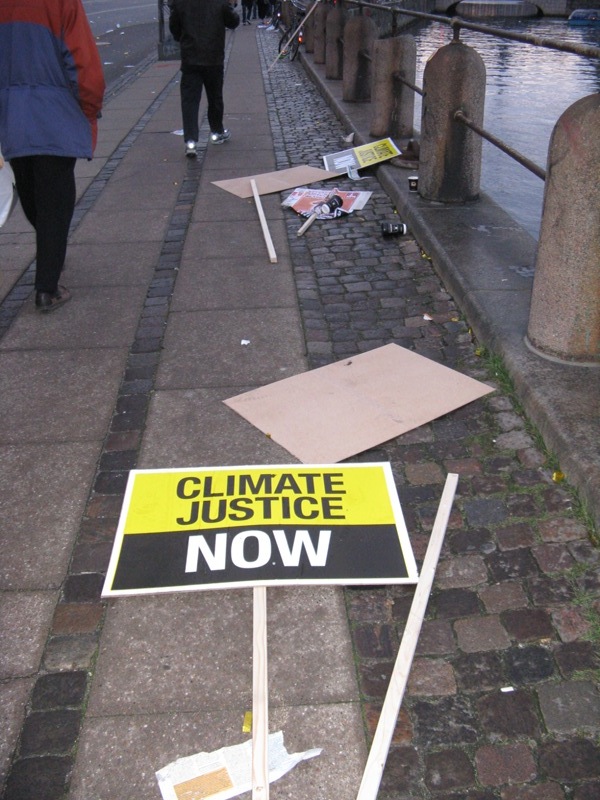
  • “Slogans to rule by: climate change messages from civil society.” Mickey Glantz. December 23, 2009

    Slogans to rule by: Street wisdom messages from civil society

    COP 15 taught me something. The best messages are the shortest messages. I attended a side event at COP 15, for example. Each speaker gave his 12-minute presentation on one of a range of climate change related issues centered on equity. More specifically, the talks were different perspectives about who should pay what to whom as a result of the saturation of the atmosphere with carbon dioxide and other greenhouse gases.

    In retrospect, the speakers gave isolated presentations, each with his (all were men) or his organization’s solutions to cope with the equity aspects of climate change. First of all, most if not all seemed to have equated equity with equality: yet they are overlapping but different concepts. Equity is about fairness; equality is about being equal. Secondly, not one of the speakers addressed points raised by previous speakers. Each came to make his statement that was usually embedded with other information. As a result, it was up to the listener to draw the appropriate conclusion as to his main message. Participants emptied the room after the session, satisfied for having attended and heard a range of papers. But, what were the take-home messages from each of the speakers? Personally, I cannot recall them.

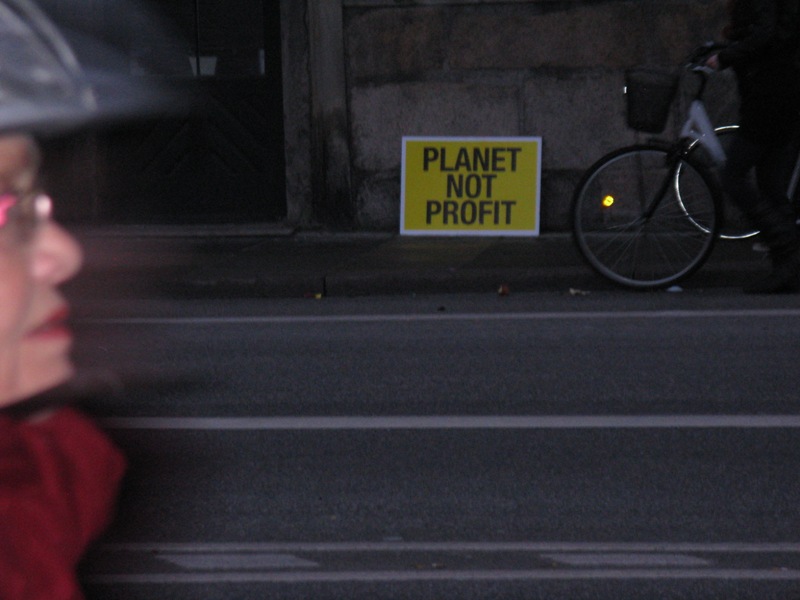
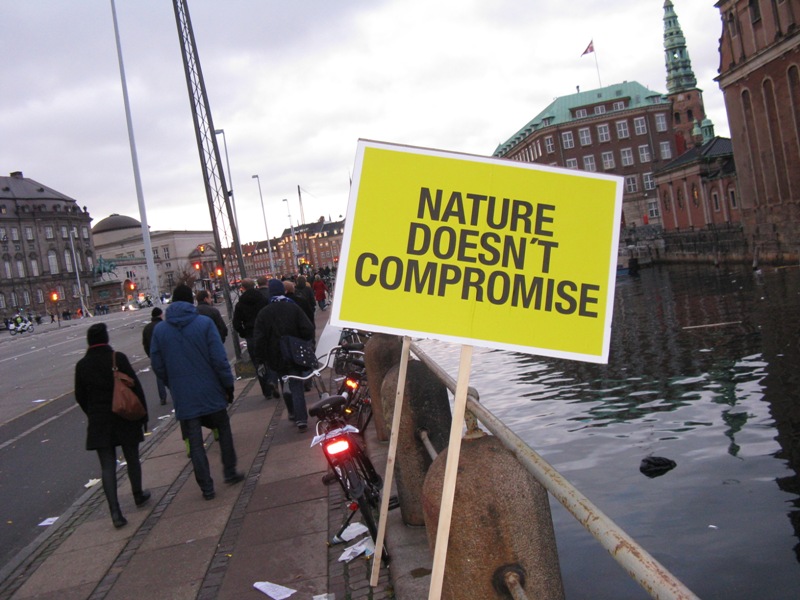
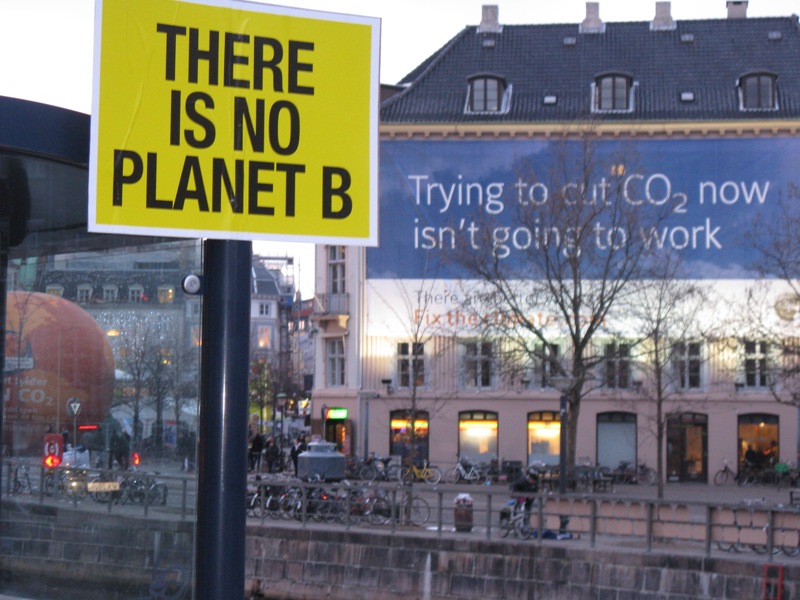
    Shift attention now to the streets of Copenhagen. At the end of the first week, there were street protests in the form of rallies and long marches from the center of town to the Bella Conference Center where the COP 15 negotiations were being held. Protesters carried placards with short-to-the-point messages for others to see, including the media. The statements on the placards provided clear and simple statements that were meant to serve as food for thought: “There is no Planet B”; “Change the system, not the climate”; “Bla, Bla, Bla”; “Nature does not compromise”, “Planet not Profit,” and so forth.

    These statements, slogans from the streets if you wish, were to the point. They were messages to leaders, negotiators, the media and the rest of civil society including global warming skeptics about what to keep in mind as they try to discuss whether or how to cope with the causes and foreseeable consequences of a changing climate. There is a lot of wisdom in these basic statements, if only people take the time to ponder their deeper meanings, hopefully influencing behavior.

    As is usually the case, the media, the politicians, negotiators and the public focus do not focus on the street wisdom adorning the placards but on the methods of delivery of those messages: the march, the gathering, the riot, the protest, etc. Yet, in my mind the true value of the demonstrations rests with the ideas succinctly stated on the placards.

    So what are the chances that policy makers or negotiators — or anyone but a protester — might pay attention to, and think more deeply about, the meanings behind the slogans on the placards by people in the streets? Society will benefit as will the policy making process if policy makers and negotiators — in this case for controlling greenhouse gas emissions — pay serious attention to those slogans. Being ignorant of an issue in one thing that can be corrected with open eyes and ears. “Ignore-ance,” that is, the deliberate rejection of useful information is more difficult to fix, because those who practice it do not want to be educated with facts.

  • ”Dreaming the Impossible Dream: Swords into Plowshares (and other economic development tools).” DAY 6 thoughts at COP 15. Mickey Glantz December 17, 2009

    {NOTE to the Reader to avoid misinterpretation: The Following editorial is about money and military expenditures for maintaining armies and for fighting wars or staying in power. The US started the wars in Iraq and Afghanistan and have put at least $1 trillion into the effort. Could those funds have been used for development purposes both in the USA and in the developing world? If there were no wars and the militaries around the globe could reduce their budgets because of a reduction in conflict (at present terrorism is seen as the major threat to government; also dictators maintain their military establishments to stay in power [the list of these is long and we all know who they are!]), governments worldwide could turn attention and funds to economic development activities with substantial funds available to do so. That is the spirit in which the following is written}.

    On the way to COP 15 at the Bella Convention Center in Copenhagen one morning, I got to thinking about both the COP 15 official UN-sponsored conference and the KlimaForum09, the public’s climate change conference. That led me to wonder about a missing element in the conferences: There was no hint anywhere of the United Nations’ basic unofficial slogan and underlying theme “Beating swords into plowshares.” Yet everyone these days is referring to climate change as a security issue.

    Just about every country in the world provides a relatively large portion of its national budgets to its military establishment. Worldwide military expenditures have been estimated at $1.1 trillion around 2005. An estimated $500 billion was from the rest of the world while the US expenditure was about $600 billion. That is just the cost to maintain the military establishments. It does not include the cost of a hot war (for example, the cost of the Iraq and Afghanistan wars to the United States has been estimated to date at more than $1 trillion).

    We have learned from previous war efforts that there seldom is a “peace dividend”, that is, when a war ends, the funds used for the war are never available for peace-building activities.

    Developing countries demand that industrialized countries (e.g., the rich countries) pay hundreds of billions of dollars annually into the future to cope with a changing climate due to the emissions of heat-trapping greenhouse gases since the mid-1700s. The demands are based on the claim that the developing countries are the victims. The demands are made in the midst of a major financial worldwide meltdown.

    The US has already spent (officially) $1 trillion on its Central Asian wars; the costs will surely rise. What if those wars were to be brought to an abrupt end and the equivalent amount of the war funds could be diverted to help developing countries successfully prepare for and cope with climate change?

    However, the fact is the US and other countries are currently besieged by terrorism. For national security they –build (or create) super-sized military establishments compared to the size of their national budgets. In the absence of threats, military establishments could in theory at least be reduced and development activities increased. So, how about considering the following scenario to fund developing country programs and projects in the face of a changing climate: Governments that support terrorist groups (morally, politically or financially) must stop terrorists from operating within their borders. If this were done funds could be transferred from the anti-terrorist hot conflicts to activities that develop their countries economically. This would constitute a “peace dividend”.

    Because governments continue to support terrorist groups, funding from rich countries will continue to flow to fight terrorists and not to development. It is ludicrous that several governments that are members of the “Group of 77 + China” (this is the largest group of developing states in the United Nations. There are now 130 members) demand large sums of financial support to cope with climate change causes and consequences, while at the same time some of these countries are supporting terrorist groups whose hostile activities requires large sums of money to combat. For example, the Sudanese representative speaking for the “Group of 77 and China” to the COP 15 climate negotiations demands $200 billion for developing countries while his government supports terrorism. Sudanese representative to the Group of 77 Lumumba Dia-ping stated the demand in the following way: “You approve billions of dollars in defense budgets. Can’t you approve 200 billion dollars to save the world?”

    Zimbabwe’s President Robert Mugabe addressed COP 15, challenging the industrialized “North” to provide more climate change related funds to developing countries. Is he the best spokesperson for more funds, because his human rights record in his country in abyssmal.

    Governments must begin to consider scenarios centered on “beating swords in to plowshares” as a way to provide the community of nations with a tangible peace dividend. Not only should they pursue equity among states in the international community but should pursue equity within their own borders as well. Not to work toward a ‘peace dividend’ scenario means business as usual, that is, hot wars, large military establishments worldwide, not to mention a thriving international arms trade. Does the slogan “Give Peace a Chance” ring a bell?
    John Lennon singing \”Give Peace a Chance\”