
…as we have come to know it
People of the 1900s learned to live with their climate regimes, from local to global. They adjusted their activities as necessary to cope with extremes and variabilities on a range of time scales that suited the attentions of their evolution, from weeks to months to seasons to years to decades. Throughout that century, the Poles (both North and South) were covered with ice, snow and floating ice. This was the way it was supposed to be, at least in terms of natural phenomena (e.g. emergence into the present interglacial period, solar dynamics, etc.) that exist at scales much longer than those of human attention or concern.
For many decades now, scientists have written about how important polar ice is to the global climate system. They have reported that a warming of one degree in the mid-latitudes would likely translate to a warming of 3 to 4 degrees in the Polar Regions. I have even referred to polar ice over the last few years as the planet’s proverbial ‘canary in the mine’—it is the early warning indicator of a warming of the Earth’s atmosphere. Achilles as a child was protected from harm, except for his heel. He was considered invincible but was eventually felled in combat by an arrow to his heel.

These scientists have also written on the importance of albedo in the polar region {albedo is a measure of how much incoming solar radiation is reflected back to space}. Indirectly, this measure of reflection also indicates how much snow and ice—how much whiteness, that is—covers those Polar Regions. The more coverage of snow and ice there is the more incoming radiation from the sun is reflected back into space after hitting the earth’s surface.

Simply put, light colors (white snow, ice, etc.) reflect, while darker colors (dark gray rocks, green fields, black waters, etc.) absorb. The planetary albedo is crucial in regulating the temperature of the planet, making it livable for humans and almost all other living species.
The fear is that a decrease in ‘whiteness”—in polar albedo—would begin a positive feedback loop by which increased area extent of darker surface waters would absorb more heat, thereby heating up the water and further decreasing the amount snow and ice, which would result in an increased amount of darker waters and ultimately result in a melting of the remaining ice leaving in its place a large expanse of darker surface water.
The end result would be, depending on the extent of the warming of the atmosphere, either a seasonal or a permanent ice-free passage between the North Atlantic and the North Pacific. The fabled Northwest Passage would be, albeit unintentionally, a reality, enabling ships to bypass the Panama and the Suez Canals as well as the Straits of Malacca and shortening travel routes for shipping goods from one part of the globe to another.

Sea level is expected to rise in this century faster and higher than previously expected, as a result of the sharply increased rate of the melting of the Arctic’s glaciers and Greenland’s ice cover. Such a rise would obviously endanger low-lying coastal areas, mega-cities on the coast and many island nations. This is not the only problem, however; there will be a land-grab for the seabed that exists now under Arctic ice.
Russia’s Valdimir Putin, for example, had already authorized the planting of a titanium Russian flag on the seabed below the sea ice to claim the land and the vast resources of oil and gas beneath it. Great for Russia . . . new reserves of oil and gas can be extracted and sold in the international marketplace to fuel growing economies. Not really great for Russia (or any other place) . . . these new sources of fossil fuels will significantly increase the amount of carbon dioxide—a major greenhouse (heat-trapping) gas in the atmosphere—and exacerbate the many problems associated with global warming.

A considerable number of science-based guesstimates about the impacts of global warming on a wide range of sectors exist. These include effects on agricultural production and changes in food insecurity; on shifting rainfall patterns and more droughts and floods; on increasingly lengthy and intense heat waves; on forest and bush fires and on living marine resources; and on the frequency and intensity as well as the location of high impact as well as record-setting extreme meteorological events.
The bottom-line is that the world of the 20th century that many of us became familiar with personally and that many individuals born over the last few decades have learned about through history books will likely be vastly different than the world that lies ahead of all humankind. That difference will likely be attributable in large measure to the consequences of global warming. It seems that governments today, however, despite their words and pledges to the contrary, are reluctant to change their dependence on (some would say addiction to) the expanding use of coal, gas, and oil.
Changes in the Arctic will change the world as we have come to know it. In many respects, therefore, the Arctic can be seen as climate’s Achilles heel.
And political leaders, among other so-called ‘stewards’ of the planet, don’t seem to care.
[U1]What does this mean? According to who or what?






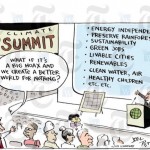

 For the past 53 years people have celebrated an Earth Day. Its beginning years were extremely valuable and eventful. Before the first official Earth Day in 1969, we were slowly emerging out of what might be called the dark ages of environmentalism; but, the decades preceding 1970 witnessed little concerted interest either nationally or globally in saving Planet Earth from the destructive ways of its human inhabitants.


 The Russian fable of Potemkin Village tells the story of a village leader who, wanting to impress the Tsar, ordered that the fronts of all the buildings that faced the main street of the village be made to look fresh and new.

 What I would like to see on clothing labels are statements that inform consumers about the life-conditions of workers who made the garments. What were their ages? Was child labor involved? What was their health status? What were their working conditions (sweatshop or not; working with dangerous chemicals or not)? What were their wages and average hours of work per day?

 Regimes (not necessarily governments!) in North Africa and the Middle East are falling swiftly now, after most of their respective leaders (autocrats and in some cases tyrants) had been in power for 20, 30 or even 40 years. These leaders have had a good run at power and corruption. To read the news you’d think that vitriol against them from outside their national borders had been ongoing during their rule, but, sadly, that is not the case. Such “bad” leaders have mostly been tolerated for a range of reasons—as political allies, as military allies, as fellow “autocrats”, as trade partners—by the enlightened, developed states of the international community. But is Qaddafi any worse today than he was three or five years ago? Was Mubarek less of a leader with a lead fist a few years ago than he was recently? No! The fact is that silence toward these autocrats and tyrants by the international community of nations was often justified in the name of sovereign rights—what happens in a country is no one’s responsibility but the rulers of that country. There have been exceptions, of course, like when a chronically bad situation becomes really ugly (or widely reported, except for the Congo) and takes on the appearance of genocide (e.g. Serbia, Rwanda). But even in those situations the international community was slow to respond because of various factors not the least important of which was the claim of sovereignty by the offending national government.